



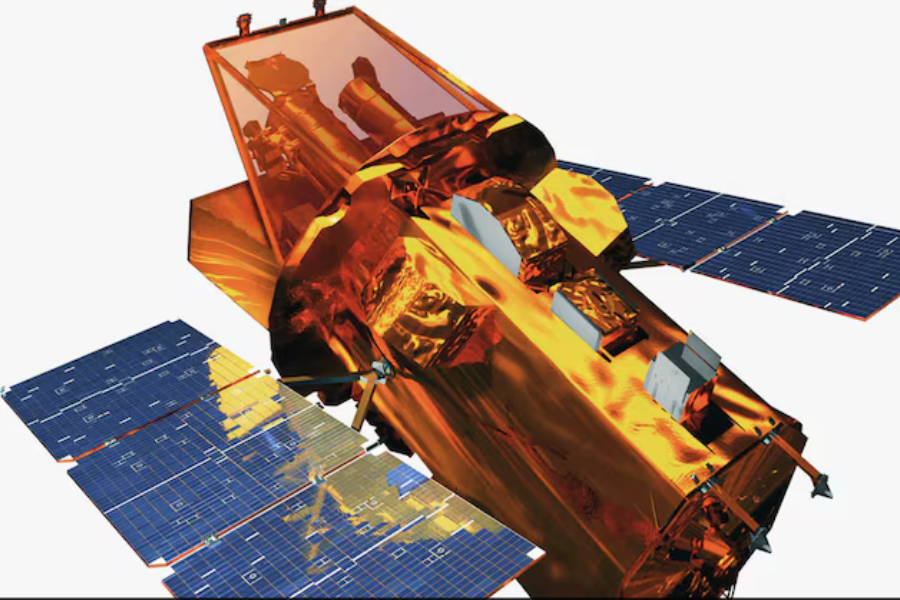
NASA Swift telescope


NASA’s Neil Gehrels Swift Observatory is expected to re-enter Earth’s atmosphere and crash on November 4. The agency expects the 1.5-tonne space telescope to enter the atmosphere at around 3:30 am ET, or 2 pm IST, with an 11-hour re-entry window.

Most of the observatory is likely to burn up during re-entry, although some components could reach Earth. Astrophysicist Jonathan McDowell of Durham University said that less than 100 kilograms could survive re-entry.
The exact location of the re-entry will depend on the telescope’s position when it enters the atmosphere. The broad re-entry zone lies between 20.6 degrees south latitude and 20.6 degrees north latitude. It includes parts of Africa, Australia, India, Southeast Asia, and Central and South America.
In India, Mumbai, Hyderabad, Bengaluru and Chennai fall within the broad latitude band. Delhi, Kolkata and much of northern India are outside it. However, being within the band does not mean that a location is directly beneath the falling debris.
ISRO’s Multi-Object Tracking Radar at Sriharikota tracks space objects during their final few orbits before atmospheric re-entry. ISRO has not stated whether it is tracking the descending telescope.
The telescope, initially known as the Swift Gamma-Ray Burst Explorer, was launched on November 20, 2004. Its mission was originally planned to last two years, but the source describes it as having operated for 22 years. During its mission, Swift observed more than 2,000 gamma-ray bursts and 1,400 supernovae.
Experts cited in the source said the chances of debris damaging infrastructure or injuring someone are extremely low. Brad Tucker, an astrophysicist at the Australian National University, noted that 70% of the Earth’s surface is ocean and 30% is land.









© Copyright 2026, cloudTV. All Rights Reserved