


Pakistan Kashmir Narrative


Pakistan has spent decades presenting the Kashmir dispute internationally through the language of self-determination and the rights of Kashmiris. But a growing civil society movement in Pakistan-administered Kashmir is now creating an uncomfortable contradiction for Islamabad.

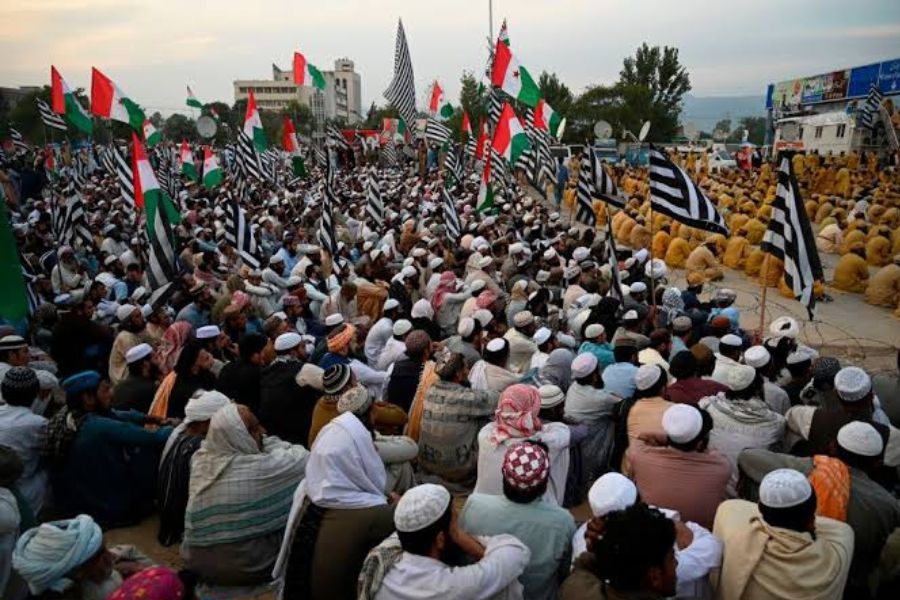
Protests that began around economic grievances have expanded into a broader movement demanding political representation, constitutional rights, fiscal transparency and greater accountability from the administration.
An analysis notes that the current unrest is not primarily a separatist movement. Instead, protesters have focused on governance and representation, making the situation particularly sensitive for Islamabad.
The Jammu Kashmir Joint Awami Action Committee, or JAAC, is at the centre of the current movement. The coalition includes traders, lawyers, students and transport workers.
The group initially consolidated around economic grievances, including flour subsidies, electricity tariffs and the rising cost of living. Some concessions were secured in earlier campaigns.
However, the movement has since expanded into a wider political and constitutional campaign.
JAAC has reportedly put forward a 38-point charter of demands. One of the central issues is the allocation of 12 reserved seats in the 45-member legislative assembly of Pakistan-administered Kashmir.
Those seats are reserved for Kashmiri refugees who live in mainland Pakistan.
The protesters have argued that the arrangement provides Islamabad with a mechanism to influence politics in the territory and divert resources away from local priorities.
That demand has broader implications because it raises questions about the extent of political autonomy available to Pakistan-administered Kashmir.
Under the 1974 Interim Constitution, the territory has its own legislative assembly, prime minister, president and Supreme Court.
Constitutional reforms in 2018 transferred some financial and legislative powers to elected representatives, but the federal government’s influence remained significant.
The resulting tension between formal autonomy and practical political control has become one of the important themes of the current unrest.
Negotiations between JAAC and the Pakistani government reportedly collapsed in May.
On June 5, Islamabad banned the organisation under anti-terrorism laws and arrested several of its leaders, according to analysis. Dozens of protesters have subsequently been killed amid clashes and a security crackdown.
The protesters, however, have rejected the suggestion that their movement is separatist.
Their demands have centred on governance, constitutional rights, political representation, fiscal transparency and accountability.
That distinction is important because Pakistan has historically framed the Kashmir dispute around the principle of self-determination.
If people living in Pakistan-administered Kashmir are themselves demanding greater political representation and accountability from Islamabad, it creates an obvious tension between Pakistan’s international messaging and its domestic governance.
The situation has also raised concerns over media restrictions.
Pakistan’s Ministry of Information and Broadcasting introduced new Foreign Media Facilitation Guidelines in early August. The rules require journalists working outside Islamabad, Lahore and Karachi to obtain permission from the ministry’s External Publicity Wing.
The regulations reportedly apply not only to foreign correspondents but also to freelancers, translators, fixers and local collaborators.
Restrictions on reporting from sensitive regions can make it more difficult for international audiences to independently assess developments on the ground.
The information environment is therefore becoming another important part of the political dispute.
The unrest in Pakistan-administered Kashmir could have consequences beyond Pakistan’s domestic politics.
Islamabad has traditionally used Kashmir as a major issue in its international diplomacy, presenting itself as an advocate for the rights and self-determination of Kashmiris.
The current protests create a difficult question for that narrative.
How can Pakistan portray itself internationally as a defender of Kashmiri political rights while facing sustained protests in the territory it administers over political representation, governance and constitutional rights?
The issue also gives New Delhi an opportunity to challenge Pakistan’s position on Kashmir.
India has consistently questioned Pakistan’s administration of territories on the other side of the Line of Control. The unrest provides another argument for New Delhi to highlight the conditions and political grievances reported in Pakistan-administered Kashmir.
At the same time, Islamabad is dealing with several other internal challenges.
Pakistan faces economic pressures, instability in Balochistan and a deteriorating security situation in Khyber Pakhtunkhwa. The unrest in Pakistan-administered Kashmir therefore adds another layer of pressure to an already stretched state.
The nature of the current movement is particularly significant.
Unlike a conventional separatist campaign, the protesters have largely focused on local governance and political accountability. Their demands therefore cannot easily be dismissed as simply part of the wider India-Pakistan dispute.
That makes the political challenge more complicated for Islamabad.
The current crisis also comes at a sensitive time for Pakistan’s international diplomacy. Islamabad is attempting to project itself as a responsible diplomatic actor in a wider geopolitical environment, while developments in Pakistan-administered Kashmir are drawing attention to domestic governance and civil liberties.
The contradiction could have reputational consequences.
What is increasingly difficult to ignore, however, is that the Kashmir question is no longer being debated only between India and Pakistan.
The protests in Pakistan-administered Kashmir have brought local voices, political representation and governance into the centre of the discussion.
For Islamabad, that could prove to be a particularly difficult challenge because the strongest questions about its Kashmir narrative are now emerging from within the territory it administers.






© Copyright 2026, cloudTV. All Rights Reserved