



Nepal Trishuli Valley floods


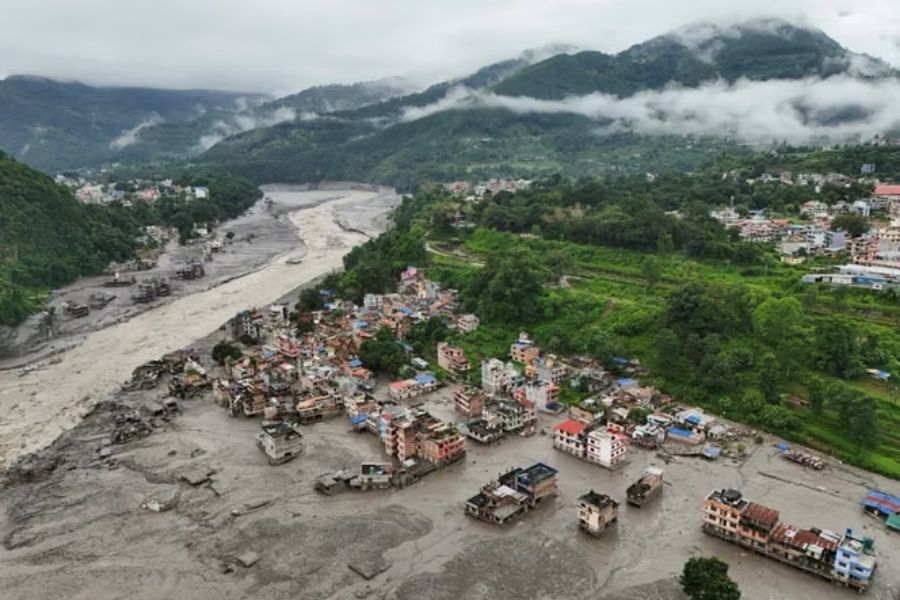
The scale of destruction in Nepal’s Trishuli River Valley has been laid bare by an helicopter report, revealing entire settlements seemingly erased by the catastrophic floods. Areas that were home to houses, shops, roads, bridges and critical infrastructure just days ago have been reduced in places to vast, featureless mud flats.

After several days of reporting from the ground in some of the worst-hit areas, the reporter’s team flew by helicopter along the Trishuli Valley towards the Rasuwagadhi border with China.
The flight passed over Bidur, Betrawoti, Dharapani, Ghumti Bazar, Ramche, Dhunche and Timure. From the air, the scale of destruction appeared even more overwhelming.
In several locations, there were no recognizable remains of buildings. Where thriving settlements had stood only days earlier, the landscape had been transformed into enormous stretches of mud. Roads, bridges, homes and commercial structures had disappeared beneath the debris.
The helicopter reached the Trishuli-3A hydropower tunnel rescue site, one of the areas hardest hit by the disaster.
The Trishuli river system contains more than a dozen run-of-the-river hydropower projects, and virtually all have been destroyed or critically damaged by the floods.
Rescuers are racing against time to reach people believed to be trapped inside underground infrastructure. But enormous quantities of mud and silt have blocked access tunnels, making the operation extremely difficult.
An excavator was being used to clear the debris, but there had been no significant progress in reaching those trapped inside at the time of the report.
The flood surge reportedly rose to the equivalent of around three-storey buildings in parts of the valley. Massive quantities of mud, rock and debris swept downstream, fundamentally altering the geography of the river corridor.
In some places, the aerial view offered almost no indication that human settlements had existed there only a few days earlier. The valley appeared to have been reshaped by the force of the flood.
The disaster has also inflicted severe damage on Nepal’s electricity infrastructure.
More than a dozen run-of-the-river hydropower projects operate along the Trishuli corridor, and virtually all of them have been destroyed or severely damaged. The losses have significantly reduced Nepal’s electricity surplus and placed additional pressure on the national power grid.
The helicopter flew towards Rasuwagadhi, close to the Chinese border. The once-important border crossing has also suffered extensive destruction.
The aerial report showed severe damage to infrastructure, while roads across the valley have been cut off in several locations. The disruption is making rescue and relief operations in remote areas considerably more difficult.
A journalist, who has covered conflicts and major natural disasters around the world, described the experience as more harrowing in many ways than covering modern warfare.
In a war, there are at least attempts to limit collateral damage. A raging river carrying enormous boulders, rock, mud and sediment offers no such distinction. Everything in its path can be destroyed.
The Trishuli Valley has seen that destructive force at close range. Hundreds of people have been confirmed dead, thousands remain missing, and families continue to wait for information about their loved ones. Some bodies may be buried beneath tonnes of mud, potentially making recovery a process that could take weeks or months—or may never be completed.
Rescue teams continue to work across the devastated valley, particularly at underground sites where people may still be trapped.
The aerial images provide a stark picture of the disaster’s scale. The destruction of settlements, transport links and power infrastructure means that recovery and reconstruction will likely be a long process.
For families waiting for news, however, the immediate priority remains the search for survivors and the recovery of those still missing.






© Copyright 2026, cloudTV. All Rights Reserved