



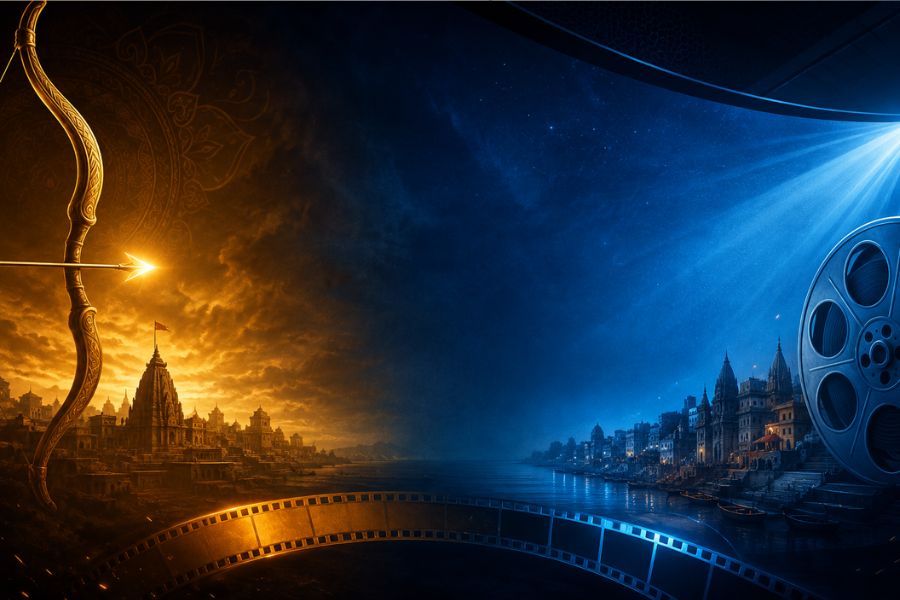
IMAX Revolution


Indian cinema may be approaching a major shift in the way big-budget films are made and experienced.

For years, IMAX in India has largely been associated with Hollywood blockbusters. But that could change with major Indian productions such as Ramayana and S.S. Rajamouli’s Varanasi entering the premium-format space.
The success of Christopher Nolan’s The Odyssey in IMAX has also brought the country’s limited premium-screen infrastructure into sharp focus.
India currently has around 34 IMAX screens. That is a relatively small network for a country with one of the world’s largest film audiences.
Two major Indian films are now at the centre of this transition.
Ramayana, the ambitious Indian epic being produced by Namit Malhotra, is being made for IMAX. Meanwhile, S.S. Rajamouli’s Varanasi, starring Mahesh Babu and Priyanka Chopra, is also being produced using IMAX-certified digital cameras.
The significance goes beyond simply releasing an Indian film in an IMAX theatre.
Filming specifically for the format requires filmmakers to consider the premium presentation from the production stage itself. Camera choices, framing, lighting, focus and sound all become more demanding.
That could create a new category of Indian films designed not only for conventional theatres but also for large-format premium experiences.
Rajamouli has already demonstrated the international appeal of large-scale Indian storytelling through films such as Baahubali and RRR. With Varanasi, the filmmaker is now attempting to combine that spectacle with a premium-format filmmaking approach.
The biggest obstacle may not be audience interest. It may be infrastructure.
PVR INOX Executive Director Sanjeev Kumar Bijli told that establishing an IMAX screen can cost approximately Rs 10-11 crore. That makes rapid expansion expensive, particularly when the commercial performance of IMAX releases can vary considerably.
The solution, according to Bijli, is more Indian content made specifically for the format.
Hindi films alone may not be enough. More Tamil and Telugu productions could help create a steady pipeline of premium-format content.
This creates a classic industry dilemma.
Filmmakers need more IMAX screens to justify the additional investment required to create premium-format films. Exhibitors, meanwhile, need more IMAX-ready films before they can confidently invest in additional screens.
Namit Malhotra has described the situation as a chicken-and-egg problem.
More screens could encourage filmmakers to take bigger creative and financial risks. At the same time, more premium-format films could give exhibitors the confidence to expand the network.
There is another challenge that audiences may not immediately notice.
Making an IMAX film requires changes at the production level.
The cameras can be significantly heavier than conventional cinema cameras. Specialised rigs and experienced crews may therefore be required.
Film-based IMAX cameras can also be extremely loud. That creates additional challenges when filmmakers need to record sync sound.
Framing is another important consideration.
A large IMAX screen can reveal a taller and more expansive image. Directors and cinematographers therefore have to pay greater attention to every part of the frame.
Focus also becomes critical because a giant screen can expose small errors that might remain unnoticed on a conventional cinema screen.
Lighting has to be equally precise.
The larger image can reveal details and imperfections that would otherwise remain hidden.
Shooting on IMAX film brings additional costs because film stock is expensive and individual rolls provide limited shooting time. Every take therefore becomes more valuable.
Filmmaker Shekhar Kapur believes IMAX remains too expensive for a normal-budget Indian production. However, he also sees the possibility that new technology and AI could eventually make multiple presentation formats more accessible to filmmakers.
For now, however, Ramayana and Varanasi represent an important experiment.
If these films succeed, they could encourage more Indian filmmakers to design large-scale productions around premium formats.
The long-term question is whether IMAX in India will remain primarily a premium destination for Hollywood blockbusters or become an important platform for Indian cinema itself.
The answer will depend on two things: whether filmmakers are willing to invest in IMAX-ready productions and whether exhibitors are prepared to expand the country’s limited premium-screen infrastructure.
The Odyssey has demonstrated that Indian audiences are willing to pay for a premium cinematic experience.
Now Ramayana and Varanasi have an opportunity to prove that Indian stories can create the same demand.







© Copyright 2026, cloudTV. All Rights Reserved