



Titan Natural Gas Reserves


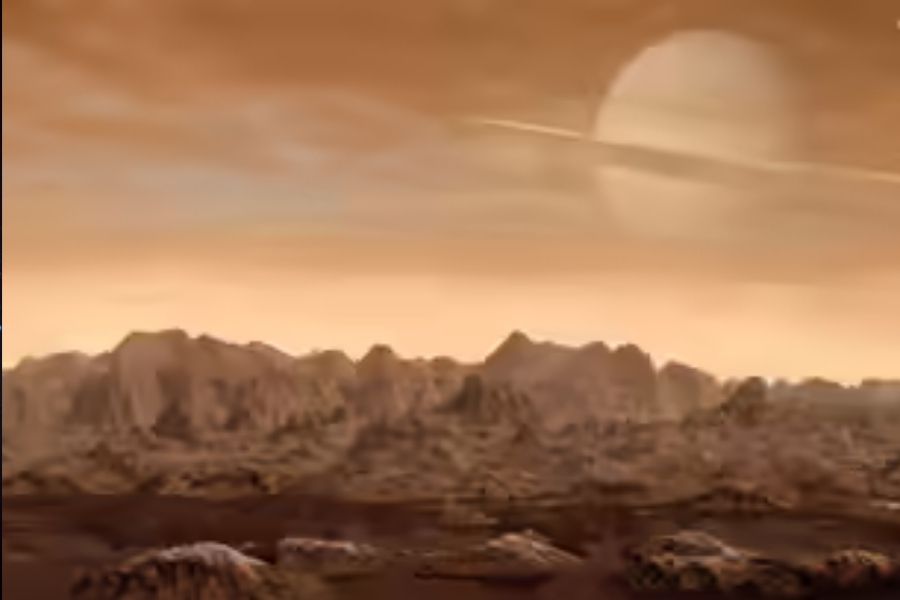
Cloud TV Desk: Saturn’s largest moon, Titan, is once again drawing the attention of scientists after a NASA-backed study suggested that it contains enormous reserves of natural gas, hydrocarbons, and water ice. Researchers say the abundance of these resources is so significant that Titan has been dubbed the “Persian Gulf of Space.”

The study, led by planetary scientist Connor Nixon of NASA’s Goddard Space Flight Center, highlights Titan’s unique potential as one of the most resource-rich worlds in the Solar System. Using data collected from the historic Cassini-Huygens mission, scientists assessed the moon’s vast stores of methane, ethane, and other hydrocarbons that could one day support future space exploration.
Unlike any other moon in the Solar System, Titan possesses a dense atmosphere primarily composed of nitrogen and methane. It is also the only known world beyond Earth with stable liquid bodies on its surface. However, instead of water, Titan’s rivers, lakes, and seas are filled with liquid methane and ethane.
Researchers estimate that Titan contains hundreds of times more hydrocarbon resources than all known oil and natural gas reserves on Earth. These hydrocarbons could potentially serve as fuel for future missions and long-term human exploration beyond Earth.
In addition to its hydrocarbon wealth, Titan is believed to contain vast quantities of water ice beneath its surface. Scientists suggest that this ice could be processed to produce oxygen and hydrogen, two critical resources for sustaining human presence and generating rocket fuel in space.
The findings have renewed interest in Titan as a potential destination for future exploration. However, significant challenges remain. Surface temperatures on Titan average around minus 179 degrees Celsius, creating an extremely cold and hostile environment for both humans and equipment.
To better understand Titan’s chemistry, geology, and habitability, NASA is preparing its Dragonfly mission, a rotorcraft designed to explore multiple locations across the moon’s surface. Scheduled for launch later this decade, Dragonfly is expected to provide unprecedented insights into one of the Solar System’s most intriguing worlds.
Scientists believe Titan could play a key role in humanity’s long-term ambitions for deep-space exploration. As research continues, the moon may prove to be one of the most valuable destinations beyond Earth for future generations.







© Copyright 2026, cloudTV. All Rights Reserved