



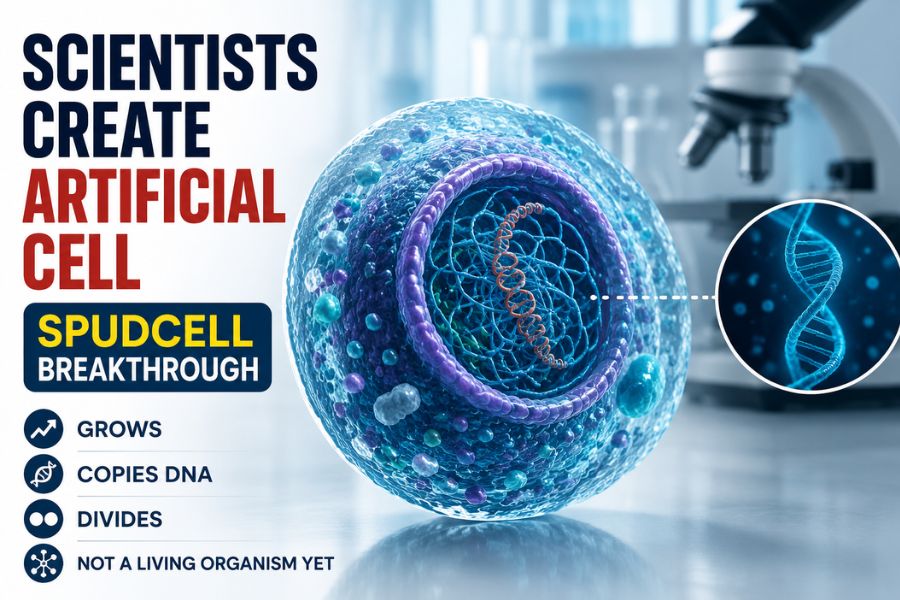
SpudCell Synthetic Cell


Cloud TV Science Desk: Scientists have taken a significant step toward creating life-like systems in the laboratory with the development of a synthetic cell called SpudCell. Although researchers emphasize that they have not created a living organism, the breakthrough demonstrates that an artificially built cell can perform several fundamental functions associated with life.

Developed by researchers in the United States, SpudCell is assembled from non-living chemical components. It is designed to mimic some of the essential behaviors of biological cells, offering scientists a powerful new platform for studying the origins of life and developing future medical technologies.
According to the research team, SpudCell can absorb nutrients from its surroundings, grow in size, replicate its DNA and divide under controlled laboratory conditions. These are among the key characteristics that distinguish living cells from non-living matter.
Researchers also observed early signs of selection-like behavior in certain experiments, suggesting that the synthetic cells may adapt in limited ways when exposed to different environmental conditions.
However, scientists stress that these findings do not mean they have created artificial life.
Despite its impressive capabilities, SpudCell lacks several critical features required for independent life.
The synthetic cell does not possess a complete metabolic system, cannot survive on its own for extended periods and still relies on externally supplied biological components to carry out essential processes. It also lacks the full cellular machinery found in naturally occurring organisms.
For these reasons, researchers describe SpudCell as a major advance in synthetic biology, rather than the creation of a fully living cell.
Experts believe the technology could have far-reaching applications across multiple scientific fields.
Artificial cells like SpudCell may eventually help scientists develop targeted cancer therapies, design personalized medicines, accelerate drug discovery and create environmentally friendly biological manufacturing systems.
The breakthrough could also provide valuable insights into one of science’s biggest mysteries—how life first emerged on Earth from non-living matter.
As synthetic biology continues to advance, researchers say ethical guidelines and international regulations will become increasingly important to ensure these technologies are developed responsibly.
While creating fully artificial life remains a distant goal, SpudCell represents one of the closest steps yet toward understanding and recreating the fundamental processes that make life possible.








© Copyright 2026, cloudTV. All Rights Reserved