


BJP and Trinamool Congress


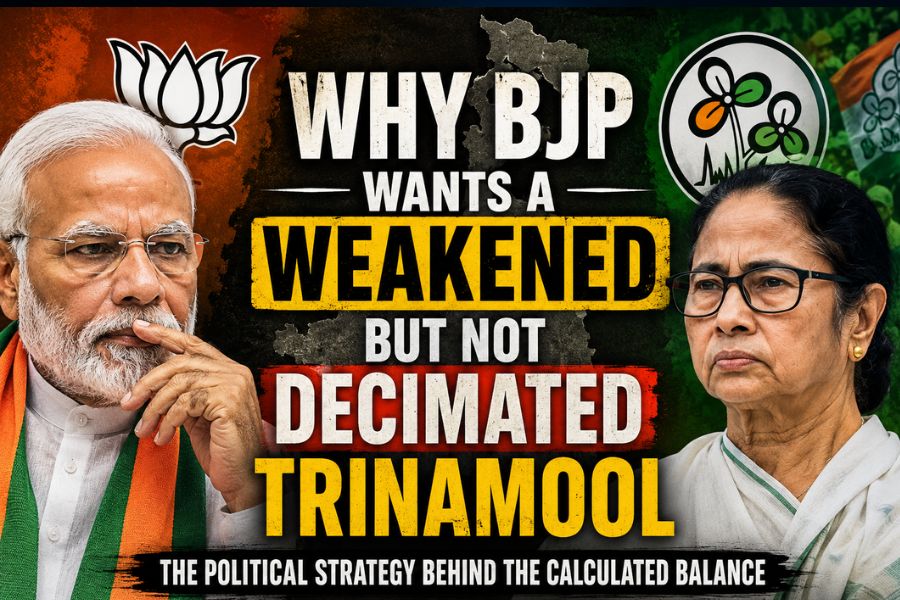
Cloudtv Desk :West Bengal’s political landscape has always been shaped by intense rivalries and shifting alliances. For nearly a decade, the contest between the Bharatiya Janata Party (BJP) and the Trinamool Congress (TMC) has defined the state’s electoral narrative. However, recent political signals indicate that the BJP may not necessarily benefit from the complete collapse of the TMC, despite years of fierce opposition to Mamata Banerjee’s party.

At first glance, the idea appears counterintuitive. Political parties typically seek to eliminate their strongest rivals. Yet, politics is often governed by strategic calculations rather than simple electoral arithmetic. In Bengal, the BJP’s long-term interests may be better served by keeping the TMC politically weakened but still relevant.
One of the primary reasons lies in the fragmentation of opposition politics. The TMC continues to possess a substantial organizational structure, a loyal voter base, and significant influence across rural and urban Bengal. If the party were to collapse entirely, its political space would not automatically transfer to the BJP. Instead, portions of its support base could migrate to the Congress, the Left Front, or newly emerging regional forces.
For the BJP, a fragmented opposition has traditionally been easier to confront than a consolidated anti-BJP alliance. The existence of a weakened TMC helps prevent the emergence of a broader opposition coalition capable of uniting anti-BJP voters under a single banner. Political strategists understand that multi-cornered contests often work to the advantage of larger national parties by dividing opposition votes.
Another factor is narrative politics. Over the past several years, the BJP has built much of its political messaging in Bengal around opposition to the TMC. Issues such as alleged corruption, political violence, governance failures, and border security concerns have formed the core of BJP’s campaign strategy in the state.
A completely weakened or irrelevant TMC would deprive the BJP of a familiar political adversary. Political campaigns often rely on clear contrasts and identifiable opponents. The TMC has served that role effectively for the BJP, allowing it to mobilize supporters and frame elections as a choice between two competing visions for Bengal.
Recent debates within BJP circles regarding the induction of former TMC leaders further highlight this strategic dilemma. While some leaders view political defections as an opportunity to strengthen the party’s organizational network, others fear excessive dependence on former TMC figures could dilute the BJP’s ideological identity. Statements from senior BJP leaders emphasizing that the party is not a “shelter home” for defectors reflect concerns about maintaining organizational discipline and preventing what some describe as the “Trinamoolisation” of the BJP.
The challenge for the BJP is therefore twofold. It must continue expanding its political footprint while avoiding the perception that it is merely becoming a new home for leaders seeking political survival after leaving the TMC.
For the TMC, these developments present both a challenge and an opportunity. While electoral setbacks and internal pressures may weaken the party, its continued relevance ensures that it remains a key player in Bengal politics. The party’s ability to reorganize, reconnect with voters, and redefine its role in opposition politics will determine its future trajectory.
Ultimately, Bengal’s political future is unlikely to be shaped by the complete dominance of a single party. Instead, it may be influenced by a complex balance of competing forces, where even rivals have strategic reasons to prefer each other’s survival. In that context, a weakened but functioning Trinamool Congress may serve the BJP’s political interests better than a vanished one.
As the state moves toward the next electoral cycle, this delicate political equation will remain one of the most closely watched developments in Indian politics.








© Copyright 2026, cloudTV. All Rights Reserved