



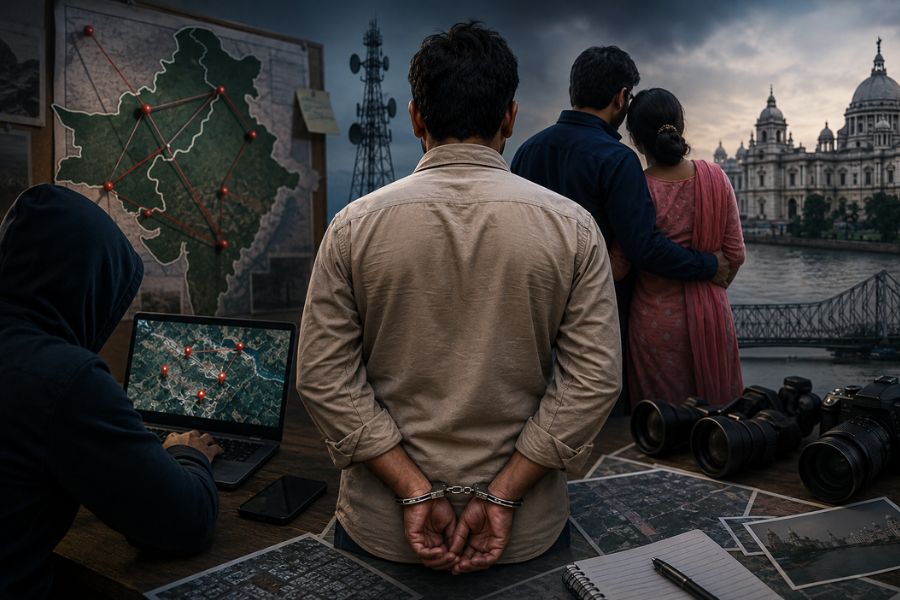
Rana Rauf ISI Network


The investigation into suspected Pakistani national Rana Rauf Khalid has widened, with West Bengal’s Special Task Force examining allegations that he was attempting to establish espionage cells in North Bengal and Kolkata.

Rauf was arrested in Habra in North 24 Parganas before he could allegedly cross the India-Bangladesh border. His associate Mohammad Izaz was also arrested from Kolkata.
Investigators are now examining whether Rauf had been attempting to build a wider intelligence network in eastern India. According to the allegations being examined by the STF, Siliguri was being used as an important base for developing contacts in North Bengal and Kolkata.
The investigators have alleged that Rauf used social media as well as direct contacts to identify and recruit people for what they describe as an “espionage cell.”
These allegations remain under investigation and have not been established in court.
Investigators are reconstructing Rauf’s movements and contacts over several years. According to the investigation, Rauf had spent a significant period in Nepal after arriving there in 2012. During his time in Kathmandu, he allegedly established contacts with several people suspected by investigators of having links with Pakistan’s intelligence network.
Investigators have also claimed that Rauf married a Nepali woman named Shilu while he was in Kathmandu. The marriage itself does not establish any intelligence connection. Investigators are examining whether his personal and professional contacts in Nepal were connected to the alleged espionage activities.
Authorities are reportedly analysing WhatsApp communications and other digital evidence to establish the nature of his contacts. The investigation has also identified phone numbers and SIM cards allegedly linked to contacts in Nepal and other countries. Rauf himself reportedly obtained two SIM cards from Siliguri. Investigators have also alleged that he broke his mobile phone while in Nepal.
Police are now attempting to determine whether the destroyed device contained information about his associates or activities. Several SIM-card dealers in Siliguri have reportedly been questioned as investigators attempt to establish how Rauf obtained the numbers and what identity documents were used.
The digital trail is expected to be particularly important because investigators may be able to recover information through other devices, cloud backups, call records and messaging data even if a physical phone has been destroyed.
Earlier, investigators claimed that digital devices linked to Rauf contained contacts connected with Pakistan, Nepal and Sri Lanka. They also said that some deleted information was recovered.
Another major line of investigation concerns Rauf’s alleged plan to leave India. According to the investigators, he was allegedly planning to cross into Bangladesh through the Bengal border and then travel onwards to Pakistan.
Investigators have claimed that Rauf intended to travel to Dhaka before taking a flight to Karachi. He was allegedly expected to travel onward to Islamabad and meet officials linked to Pakistan’s intelligence establishment.
The exact nature of this alleged plan remains under investigation. Rauf was reportedly arrested before he could leave India. Authorities are also examining whether contacts in Bangladesh were involved in facilitating his proposed journey. The alleged cross-border connections have expanded the scope of the investigation beyond West Bengal.
Investigators are now looking at possible links involving India, Nepal, Bangladesh and Pakistan. They are also examining the role of Mohammad Izaz, who was arrested separately in Kolkata.
According to the allegations, Izaz had been in contact with Rauf and may have assisted him in establishing himself in Kolkata. Investigators are trying to determine how long the two men knew each other and what activities they were allegedly involved in. The case has already attracted national-security attention because investigators previously claimed to have recovered photographs and maps of Fort William in Kolkata.
Fort William is the headquarters of the Indian Army’s Eastern Command. The reported recovery has therefore become an important part of the investigation, although possession of photographs or maps alone does not establish espionage.
Investigators would need to determine how the material was obtained, whether it contained restricted information and whether it was transmitted to any foreign intelligence organisation.
The authorities are also examining whether the alleged network collected information relating to military installations, border security or other strategic infrastructure.
However, no major terror attack plot has been conclusively established from the information currently available. The investigation is continuing with assistance from intelligence and security agencies. The central questions now are whether Rauf actually operated on behalf of the ISI, how many people were allegedly recruited into his network and whether any sensitive information was transmitted outside India.
Investigators are also trying to establish whether his Nepal and Bangladesh contacts formed part of a coordinated network or were unrelated personal connections.
The case highlights the importance of digital evidence in modern espionage investigations.
Even when a suspect destroys a mobile phone, investigators can potentially reconstruct communication patterns through other devices, call records, SIM registration information and contacts.
For now, the allegations against Rauf remain allegations.
His reported contacts, alleged recruitment activities and the recovery of Fort William-related material will have to be tested through forensic evidence and judicial proceedings.
If investigators establish that an organised network was operating across North Bengal and Kolkata, the case could become a significant national-security investigation.
For the moment, however, authorities are continuing to piece together the alleged network and determine whether it represented a genuine foreign intelligence operation or whether some of the claims will ultimately remain unsubstantiated.





© Copyright 2026, cloudTV. All Rights Reserved