



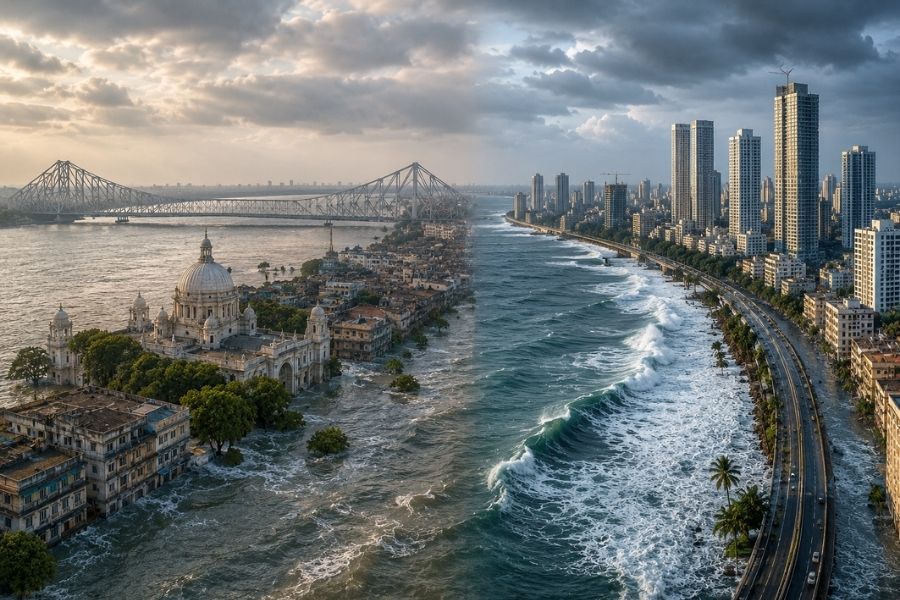
rising sea levels Kolkata Mumbai


Rising sea levels are no longer a distant climate threat. They are already affecting coastal communities around the world, and the United Nations has warned that millions of people in major South Asian cities could face severe consequences in the years ahead.

A recent UN report has identified Kolkata and Mumbai among the major low-lying cities facing an “immediate risk” from rising seas and permanent inundation. The UN says more than 14 million people across Kolkata, Mumbai and Dhaka are at risk of losing their homes, livelihoods and lives as coastlines are increasingly threatened.
The UN Secretary-General’s report, titled Challenges related to sea level rise and ways and approaches to address it, describes rising seas as one of the most profound and rapidly accelerating threats facing populations around the world.
Global sea levels rose by an average of 4.7 millimetres per year between 2014 and 2023. In 2024, the rate reached a record 5.9 millimetres per year, according to the UN.
The acceleration is being driven primarily by human-induced climate change. Melting glaciers and ice sheets are adding water to the oceans, while warming seawater expands through thermal expansion.
The UN has specifically highlighted low-lying delta cities such as Kolkata, Mumbai and Dhaka. More than 14 million people across the three cities are considered vulnerable to losing their homes, livelihoods and lives as sea levels rise and coastlines are progressively inundated.
The consequences extend far beyond residential areas. Ports, transport infrastructure, freshwater supplies, agriculture, fisheries and tourism could all face increasing pressure.
For densely populated coastal cities, permanent or recurring flooding could also create large-scale displacement and place additional pressure on public infrastructure and essential services.
The UN has stressed that sea-level rise is not simply an environmental problem. It has implications for public health, food security, human rights, economic development, culture and community identity.
Saltwater intrusion can contaminate freshwater sources and agricultural land, while coastal erosion can damage homes and livelihoods. Fisheries and tourism-dependent communities are also particularly vulnerable.
The effects can extend far beyond the coastline. Displacement from vulnerable coastal areas can create economic and social pressures in inland regions as people search for safer places to live and work.
Kolkata is connected to the low-lying Ganges-Brahmaputra-Meghna delta system, making the wider region particularly sensitive to changes in sea level, coastal flooding and extreme weather.
The UN has called for integrated approaches that connect river basins, freshwater systems, coastlines and oceans with land-use and regulatory planning. The organisation has stressed that fragmented policies are insufficient to address the scale of the challenge.
The UN says some amount of sea-level rise is already locked in. However, the extent of future damage will depend significantly on how quickly greenhouse gas emissions are reduced and how effectively vulnerable communities adapt.
For cities such as Kolkata and Mumbai, experts and policymakers will need to focus on stronger coastal infrastructure, improved drainage and flood-management systems, protection of freshwater resources and long-term climate-resilient urban planning.
The UN’s warning is clear: rising seas are not merely a problem for future generations. The impacts are already unfolding, and densely populated coastal cities such as Kolkata and Mumbai are increasingly exposed.







© Copyright 2026, cloudTV. All Rights Reserved