



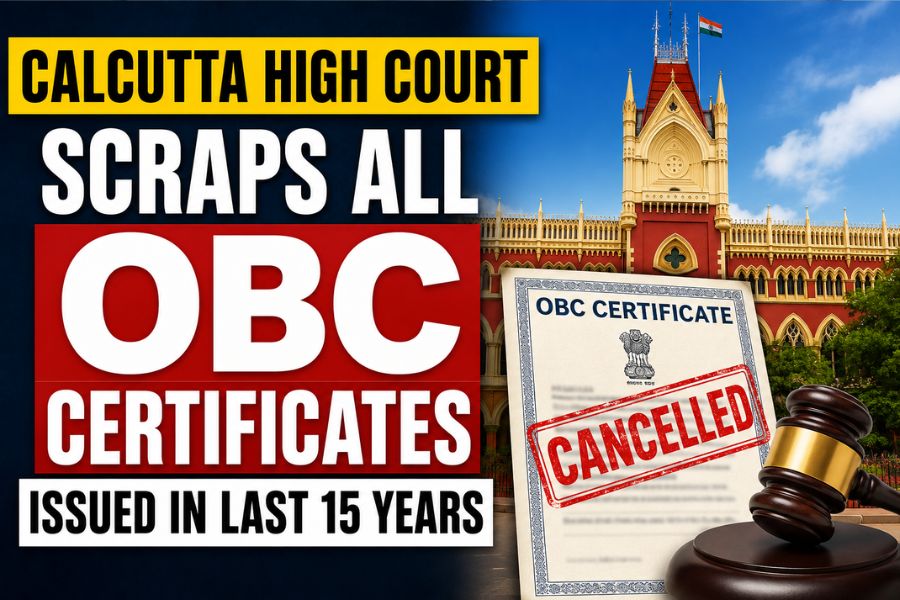
OBC Certificate


The controversy surrounding OBC certificates in West Bengal has once again come into focus, with the legal and political debate over the state’s Other Backward Classes list continuing to remain unresolved.

The issue goes back to a major Calcutta High Court judgment delivered in May 2024. The court examined the process through which several communities were included in the state’s OBC list after 2010 and raised serious questions about the procedure followed by the state government.
The ruling had implications for OBC certificates issued after 2010 and triggered a major political controversy in West Bengal.
The matter is significant because OBC status directly affects access to reservation in government employment and educational institutions.
The 2024 Calcutta High Court judgment examined a series of executive orders issued between 2010 and 2012 through which 77 groups were brought under the OBC category.
The court also examined the inclusion of 37 sub-categories and questioned whether the prescribed legal and institutional procedure had been followed.
A key issue before the court was the role of the West Bengal Backward Classes Commission in recommending communities for inclusion in the OBC list.
The court stressed the importance of following an objective and legally prescribed process while determining whether a particular community qualifies for OBC status.
The judgment resulted in uncertainty surrounding OBC certificates issued after 2010. Several reports estimated that around five lakh certificates could be affected by the ruling.
The issue subsequently became a major political flashpoint, with the BJP accusing the Trinamool Congress government of using OBC reservations for political purposes.
The state government, however, rejected such allegations and maintained that its reservation policies were intended to benefit socially and economically backward communities.
The legal controversy did not end with the 2024 judgment.
In 2025, the Calcutta High Court also intervened in the West Bengal government’s process of preparing and notifying a revised OBC list.
The court granted an interim stay on the state’s notification and raised questions about the process used to classify communities under the OBC category. The revised list contained 140 communities, while the court specifically directed attention towards 66 communities.
The court questioned whether the state had followed the required statutory procedure and whether an appropriate survey had been conducted.
The bench also questioned why the state had partly relied on the 2012 framework and then returned to the 1993 law.
According to reports on the proceedings, the court observed that the state had been providing benefits for years but had not carried out the required periodic exercise to reassess the OBC list.
The dispute has practical consequences. The state government had indicated that recruitment and college admissions were being affected by the legal uncertainty surrounding the OBC list.
The issue is therefore not merely political. It directly concerns people seeking government jobs, college admissions and other benefits under the reservation system.
The OBC controversy has also intensified the political battle between the ruling Trinamool Congress and the BJP in West Bengal.
The BJP has repeatedly alleged that the state’s OBC policy was influenced by vote-bank considerations.
The Trinamool Congress and the state government have rejected the allegation and defended their efforts to provide reservation benefits to disadvantaged communities.
At the heart of the legal dispute, however, is a larger constitutional question: how should OBC communities be identified and classified, and what process must governments follow before extending reservation benefits?
The court’s intervention has highlighted the importance of following statutory procedures, conducting appropriate surveys and ensuring that classification is based on objective criteria.
For thousands of certificate holders, the immediate concern is the status of their existing documents and whether previous benefits received through OBC reservation will be affected.
The legal position may also have consequences for recruitment and admissions where OBC certificates are required.
The subsequent dispute over the revised OBC list demonstrates that the issue remains legally active.
The next phase will depend on further court proceedings, the state’s approach to revising the list and the legal process followed for identifying eligible OBC communities.
For West Bengal, the challenge will be to balance reservation policy with constitutional safeguards, transparent classification and the rights of communities that genuinely qualify for affirmative action.








© Copyright 2026, cloudTV. All Rights Reserved