



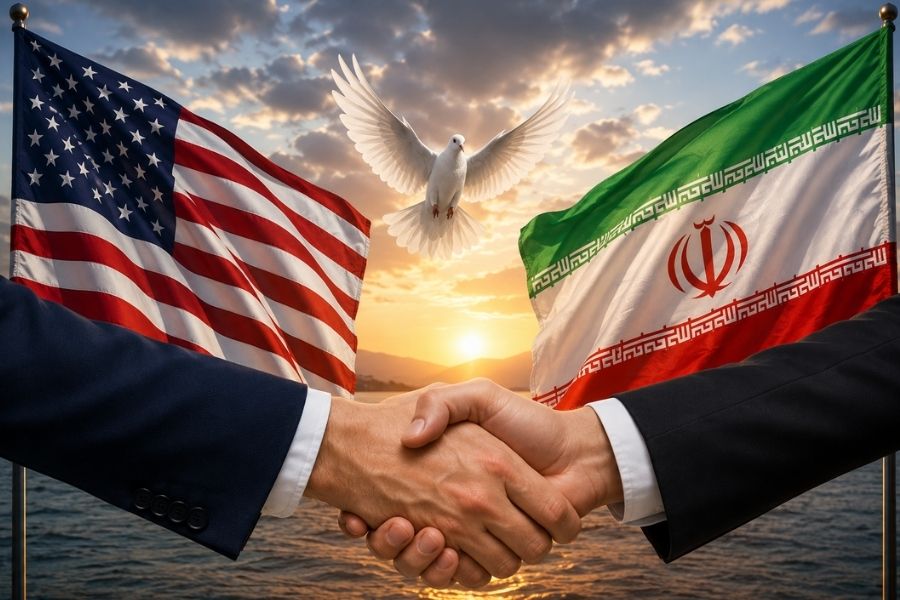
US-Iran Peace Deal


Cloud TV Desk: The United States and Iran are reportedly moving closer to a historic peace agreement that could formally end more than three months of conflict in the Middle East. If negotiations proceed as planned, both countries are expected to sign a peace deal in Switzerland on June 19.

While neither Washington nor Tehran has officially released the terms of the proposed agreement, Iran’s Mehr News Agency has reported details of a draft framework containing 14 major conditions aimed at de-escalating tensions and restoring regional stability.
According to the report, the agreement calls for an immediate and permanent ceasefire across the Middle East, including conflict zones linked to Lebanon. The United States would also commit to respecting Iran’s sovereignty and refrain from interfering in the country’s internal affairs.
One of the most significant provisions involves the Strait of Hormuz, a critical global energy shipping route. The draft reportedly requires the United States to lift its naval blockade within 30 days, while Iran would ensure the safe and unrestricted passage of commercial vessels through the strait.
The proposed deal also includes the withdrawal of U.S. military forces from Iran and nearby operational zones. In addition, all sanctions and restrictions on Iranian oil and energy exports would be removed, allowing Tehran to re-enter global energy markets.
To support post-war recovery efforts, the United States and allied nations are expected to provide approximately $3 billion in reconstruction assistance for war-damaged regions of Iran.
The draft agreement also outlines a 60-day dialogue process on Iran’s nuclear program. Tehran would reaffirm its commitment to the Nuclear Non-Proliferation Treaty (NPT) and pledge not to develop nuclear weapons. During the negotiation period, Washington would refrain from imposing new sanctions or deploying additional military assets to the region.
Another key provision reportedly requires the United States to return Iranian assets that were previously frozen or confiscated. A monitoring mechanism would also be established to verify compliance with the terms of the agreement.
Despite the apparent progress, several challenges remain. Former U.S. President Donald Trump has indicated that the Strait of Hormuz would be fully reopened only after the peace agreement is formally signed, leaving room for uncertainty in the days leading up to the proposed ceremony.
Israel’s role remains another major obstacle. Israeli forces reportedly carried out strikes against Hezbollah-linked positions in Lebanon on Sunday despite calls for restraint. Iran has repeatedly insisted that developments in Lebanon must be included within the broader peace framework.
Analysts warn that while the proposed agreement represents a significant diplomatic breakthrough, the period before June 19 remains highly sensitive. Any military escalation involving Israel, Hezbollah, or regional actors could still impact the final outcome.
If successfully implemented, the agreement could reshape Middle Eastern geopolitics, stabilize global energy markets, and reduce one of the world’s most significant geopolitical flashpoints.







© Copyright 2026, cloudTV. All Rights Reserved