


UP Politics 2027


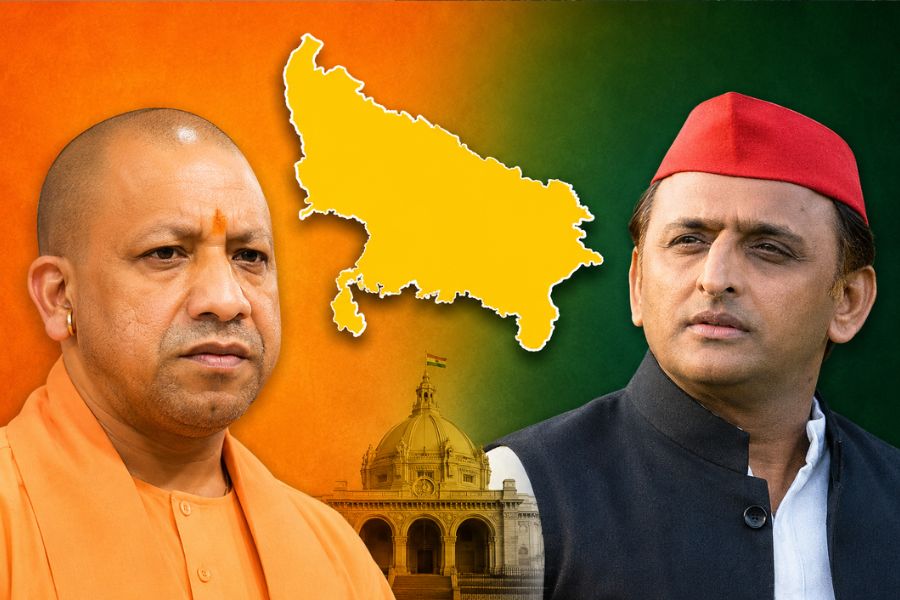
The political battle for the 2027 Uttar Pradesh Assembly election is already taking shape, with the BJP and the Samajwadi Party emerging as the principal contenders.

Chief Minister Yogi Adityanath remains the BJP’s strongest individual political face. The party is expected to campaign around development, law and order, investment and Hindutva while simultaneously working to strengthen its social coalition.
The Samajwadi Party, led by Akhilesh Yadav, is focusing on expanding its PDA strategy involving backward communities, Dalits and minorities. The outcome could depend heavily on whether the SP can expand this coalition beyond its traditional Yadav-Muslim support base.
The BJP has already begun preparing its organisational machinery for the crucial state election. Party president Nitin Nabin recently held one-on-one meetings with around 20 Uttar Pradesh MPs to understand the ground situation.
Caste equations and the morale of grassroots workers reportedly featured prominently in these discussions. The consultations underline the BJP’s effort to identify weaknesses and strengthen its electoral machinery well before the campaign begins.
Yogi Adityanath remains central to the BJP’s strategy. Having served as chief minister since 2017, he has built a strong political identity around law and order, welfare, infrastructure and Hindutva.
However, the BJP cannot ignore the lessons of the 2024 Lok Sabha election. The party won 33 of Uttar Pradesh’s 80 parliamentary seats, while the Samajwadi Party won 37 and Congress six. The SP-Congress alliance therefore demonstrated that opposition consolidation can significantly disrupt the BJP’s dominance in the state.
The BJP’s challenge will be to retain its upper-caste, OBC and Dalit support while preventing further erosion among sections of non-Yadav OBC voters.
Akhilesh Yadav is attempting to turn the PDA formula into the core of the SP’s 2027 campaign.
The strategy seeks to unite backward communities, Dalits and minorities. But the SP appears increasingly aware that a narrow Yadav-Muslim coalition will not be enough to defeat the BJP in a state with such a complex social structure.
Recent political messaging suggests that the SP is trying to broaden its appeal. The party has also shown signs of reaching out to Brahmin voters, indicating that its social strategy could become more expansive ahead of the election.
Akhilesh has said that the SP will approach the 2027 election through electoral equations. That indicates that caste arithmetic, candidate selection and alliances are likely to remain central to the party’s campaign planning.
The Dalit vote will be another major battleground. The Bahujan Samaj Party, once the dominant political vehicle for Dalit voters in Uttar Pradesh, has suffered a significant decline. This has opened space for the BJP, SP and Congress to compete for Dalit support.
Chandrashekhar Azad has also emerged as an additional factor in Dalit politics, making the vote more fragmented and unpredictable.
The future of the SP-Congress alliance may be one of the biggest variables in the 2027 election.
The two parties won 43 of Uttar Pradesh’s 80 Lok Sabha seats together in 2024. SP won 37 seats while Congress won six. That performance has encouraged both parties to continue exploring cooperation.
However, seat-sharing could become difficult. Congress has signalled that it wants a substantially larger role in the Assembly election. Uttar Pradesh Congress in-charge Rajendra Pal Gautam has indicated that the party would seek an equal and respectful seat-sharing arrangement with the SP.
Akhilesh Yadav, meanwhile, has continued to support opposition unity. His meeting with Rahul Gandhi in July fuelled further speculation about negotiations over the electoral arrangement.
For the BJP, the central challenge will be maintaining its broad social coalition while keeping its organisational machinery united.
For the SP, the challenge is even more complex: it must expand the PDA coalition, retain Muslim and Yadav voters, attract sections of non-Yadav OBC and Dalit voters, and ensure that Congress remains aligned.
As of now, the BJP has the advantage because of Yogi Adityanath’s strong personal profile, organisational strength and established electoral machinery. But the 2027 election is far from a one-sided contest.
The final outcome could depend on three critical variables: the direction of OBC voting, the fragmentation or consolidation of the Dalit vote, and the effectiveness of the SP-Congress alliance.
In that sense, the 2027 Uttar Pradesh election is shaping up as much more than a simple BJP-versus-SP contest. It could become a battle over caste arithmetic, coalition management and the ability of each side to convert political momentum into booth-level votes.







© Copyright 2026, cloudTV. All Rights Reserved