



Makkah Defence Pact


The security architecture of South Asia and West Asia is undergoing another significant shift.

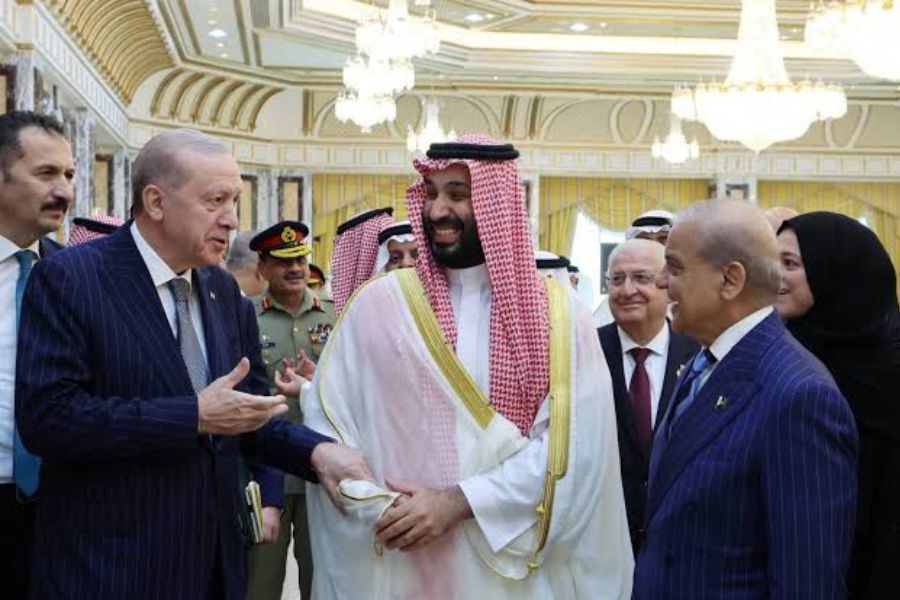
On August 7, 2026, Pakistan, Saudi Arabia and Türkiye signed the Makkah Joint Defence Agreement, establishing a new trilateral security framework. Its central provision states that an armed attack against any one of the three countries will be regarded as an attack against all three.
Pakistan’s Foreign Minister Ishaq Dar has described the agreement as “purely defensive” and stressed that it is not directed against any particular country.
For New Delhi, however, the development deserves close attention.
The Indian security establishment has already experienced the challenges created by Pakistan’s external military partnerships.
On July 4, 2025, Deputy Chief of Army Staff Lieutenant General Rahul R Singh said India had effectively faced three adversaries during Operation Sindoor.
Pakistan was the frontline combatant, while China provided important support and “live inputs” on Indian operational deployments. Türkiye, meanwhile, was accused of providing drones and trained personnel to Pakistan.
The significance of those remarks goes beyond the 2025 conflict.
They highlighted how a future India-Pakistan confrontation could involve a much wider ecosystem of intelligence, surveillance, drones, air defence and military technology.
The Makkah pact now adds another layer. Saudi Arabia is not merely a regional power. It is also one of India’s most important strategic and energy partners.
India-Saudi bilateral trade reached approximately $43 billion in 2023-24. The relationship has expanded beyond oil to include investment, security, infrastructure and strategic cooperation.
That makes Riyadh’s growing defence relationship with Islamabad particularly significant for New Delhi. However, describing the Makkah agreement as an anti-India alliance would currently go beyond the available evidence.
The three signatories have publicly framed the pact as defensive, and no specific adversary has been named.
The Saudi-Pakistani defence relationship did not begin with the Makkah agreement.
On September 17, 2025, Saudi Arabia and Pakistan signed a Strategic Mutual Defense Agreement in Riyadh. The agreement stated that aggression against either country would be considered aggression against both.
That arrangement acquired practical significance during the 2026 Middle East conflict.
In April 2026, Saudi authorities confirmed that Pakistan had deployed military personnel and fighter aircraft to strengthen the Kingdom’s security under the existing defence cooperation framework.
This matters because it demonstrates that the Saudi-Pakistani security relationship is not purely symbolic.
Pakistan also has long-standing economic ties with Saudi Arabia. Riyadh has repeatedly provided financial support and deposits to Islamabad during periods of economic stress.
The defence relationship therefore sits within a much broader political and economic partnership. Saudi Arabia brings financial resources, energy influence and a strategically important position in the Gulf.
Pakistan brings manpower, military experience and nuclear deterrence. Türkiye adds another dimension.
Türkiye has developed a substantial defence relationship with Pakistan.
The two countries have cooperated in naval technology, drones and military modernisation.
Pakistan’s Navy acquired four MILGEM-class corvettes under a Turkish-Pakistani programme, with the project involving construction in both Türkiye and Pakistan.
Turkish drone technology has also become an important component of Pakistan’s defence relationship with Ankara.
That relationship became politically sensitive in India after Operation Sindoor, when Turkish support for Pakistan attracted strong criticism in New Delhi.
Türkiye’s defence industry has also been expanding rapidly. Its fifth-generation KAAN fighter programme has attracted international attention, while Pakistan has been discussed as a potential future customer or industrial partner. There is, however, no need to treat such possibilities as a completed procurement agreement.
The broader point is that Ankara can bring defence technology, industrial expertise and military experience to the trilateral framework. That combination makes the pact strategically more significant than a conventional diplomatic declaration.
The biggest issue for New Delhi is the interaction between Saudi Arabia’s relationship with India and its relationship with Pakistan. India and Saudi Arabia have built a broad strategic partnership over several years.
The two countries cooperate in energy, investment, trade, counterterrorism and security. At the same time, Saudi Arabia has maintained an exceptionally close relationship with Pakistan for decades.
The Makkah pact effectively places those two relationships inside a new regional security framework. That does not automatically mean Saudi Arabia would participate in a future India-Pakistan war.
The exact political and military mechanisms for implementing the agreement will matter enormously. This is where comparisons with NATO need to be treated carefully.
The pact contains a collective-defence principle similar in broad concept to NATO’s Article 5. But NATO itself does not mean an automatic identical military response by every member; each ally determines the action it considers necessary.
The Makkah agreement is also a new and relatively untested framework. There is no established NATO-style integrated command structure comparable to the Atlantic alliance.
There is no evidence yet of a permanent trilateral military force. And the real test will come only if one of the three countries faces a serious armed attack.
For India, the immediate response therefore need not be alarmist. Instead, New Delhi is likely to focus on diplomacy, intelligence and strategic preparedness. Maintaining strong relations with Riyadh will be particularly important.
India also needs to track the evolution of Turkish defence cooperation with Pakistan and the possibility of deeper military-industrial integration between the three countries.
The Chinese factor cannot be ignored either. Operation Sindoor demonstrated the extent to which Chinese military equipment and battlefield support can influence Pakistan’s capabilities.
If Pakistan’s relationship with China continues to deepen while its defence ties with Türkiye and Saudi Arabia expand, India could increasingly face a more interconnected security environment.
The most important point is that the Makkah agreement should not yet be described as a full-fledged military alliance comparable to NATO. It is better understood as an emerging regional security framework. The motivations of the three countries are also different. Pakistan seeks strategic depth, stronger deterrence and continued support from powerful partners.
Saudi Arabia wants greater security autonomy at a time when the regional security environment is increasingly uncertain. Türkiye is expanding its influence and defence-industrial footprint across the wider Islamic world. These interests overlap, but they are not identical. That could eventually become the pact’s greatest strength—or its biggest weakness.
If the three countries develop joint exercises, intelligence-sharing mechanisms, defence-production programmes and coordinated military planning, the agreement could become a significant regional institution.
If they do not, it may remain largely political.
For India, the message is nevertheless clear. The old assumption that an India-Pakistan confrontation would remain geographically and strategically confined to South Asia is becoming increasingly difficult to sustain.
Operation Sindoor showed the importance of China and Türkiye. The Makkah agreement introduces Saudi Arabia into the wider strategic equation.
New Delhi therefore has a new variable to manage—not necessarily a new enemy, but a new network of relationships that could influence the next regional crisis.
The real question is no longer simply whether Pakistan has allies. It is how far those partnerships can be converted into coordinated military capability when a crisis actually begins. That is the strategic question India will be watching most closely.






© Copyright 2026, cloudTV. All Rights Reserved