


JCD Prabhakar


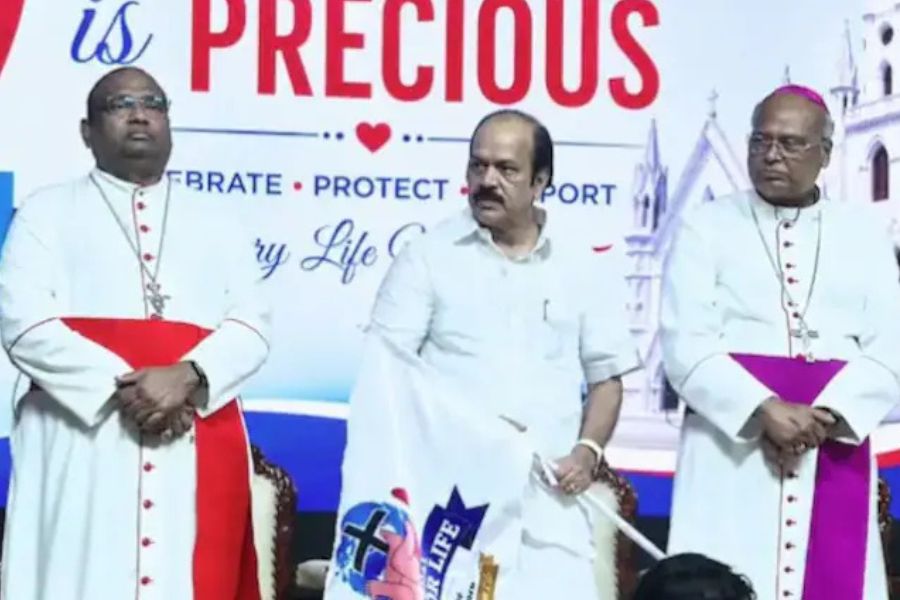
A political controversy has erupted in Tamil Nadu after Assembly Speaker and Tamilaga Vettri Kazhagam leader JCD Prabhakar participated in an anti-abortion rally in Chennai.

Prabhakar attended and addressed the fifth National March for Life India, a gathering focused on opposing abortion and promoting the protection of unborn life.
During his address, Prabhakar said that “life begins at conception” and spoke about the dignity of unborn children.
His participation and remarks have drawn criticism from activists and political opponents, who have questioned whether a constitutional office-holder should publicly endorse an anti-abortion campaign.
The controversy centres on Prabhakar’s comments at the Chennai gathering.
He said every unborn child has dignity and described children as blessings from God. He also argued that the pro-life position should not be viewed only through the question of the child.
The event itself was explicitly critical of abortion and raised questions about India’s Medical Termination of Pregnancy framework. The remarks have therefore triggered a wider debate.
At the centre of that debate is a basic question: can an elected constitutional authority publicly associate himself with a campaign seeking to influence abortion policy?
Critics argue that abortion is not simply a moral or religious issue.
It is also a medical and reproductive-health issue that directly affects women.
They say political leaders should therefore be careful when endorsing campaigns that seek to restrict or challenge existing reproductive-health protections.
Supporters of Prabhakar’s position, however, could argue that elected representatives retain the right to express their personal moral and religious beliefs. The controversy becomes more complicated because Prabhakar is not merely a legislator. He is the Speaker of the Tamil Nadu Legislative Assembly.
That constitutional position brings questions of political neutrality and public responsibility into the debate.
Prabhakar’s political identity adds another dimension to the controversy.
He is a senior figure in Tamilaga Vettri Kazhagam, the party led by actor-turned-politician C. Joseph Vijay. TVK emerged as a major force in Tamil Nadu politics following the 2026 Assembly election, with Vijay becoming Chief Minister and Prabhakar being elected Speaker.
That means Prabhakar’s comments could potentially raise questions about the political direction of the new government.
Is the anti-abortion position simply Prabhakar’s personal belief?
Or does it reflect a broader position within TVK?
That distinction could become important. Tamil Nadu has a distinctive political history shaped by social reform, rationalism and strong debates over religion and public policy. The participation of a senior constitutional office-holder in a pro-life campaign therefore carries significance beyond the immediate abortion debate.
For TVK, the issue also presents a political communication challenge. The party has positioned itself as a new alternative in Tamil Nadu politics.
Any perception that it is moving towards religiously influenced social-policy positions could trigger a wider debate about its ideological direction.
India’s abortion framework is another key part of the controversy. The Medical Termination of Pregnancy Act allows abortion under specified circumstances and subject to legal and medical conditions.
This places India between two competing approaches. One approach focuses on reproductive healthcare and a woman’s ability to make decisions within the legal framework.
The other, commonly associated with the pro-life movement, places greater emphasis on the moral and legal status of unborn life from conception.
The two perspectives have generated political and legal debates in many countries.
India has had its own debate over how abortion should be regulated while balancing women’s health, reproductive autonomy and the protection of fetal life. Prabhakar’s remarks have brought that broader debate into Tamil Nadu politics.
There is also a question about the role of religion. The Chennai march was associated with Christian organisations and promoted a pro-life position.
Critics have therefore questioned the participation of a constitutional office-holder in a religiously associated campaign. The issue is not whether an individual is entitled to hold religious beliefs.
That right is protected within India’s democratic framework. The question is whether someone occupying a constitutional position should publicly align with a campaign associated with a particular religious community or moral movement.
That distinction is likely to remain central to the political debate. For TVK, the controversy comes at a sensitive moment. The party is still establishing its political identity after making a dramatic entry into government.
Vijay’s administration will face scrutiny over how it balances individual freedoms, social policy and Tamil Nadu’s established political traditions. Prabhakar’s appearance at the anti-abortion rally has therefore opened a debate that extends well beyond one speech.
It touches reproductive rights, constitutional neutrality, religion, political identity and the future direction of Tamil Nadu’s new ruling establishment. The immediate question is whether TVK will distance itself from Prabhakar’s remarks or allow them to remain his personal position.
The longer-term question is even more significant. As Vijay’s TVK begins to govern Tamil Nadu, what kind of social and ideological politics will it represent?
That question may now be harder to avoid.







© Copyright 2026, cloudTV. All Rights Reserved