



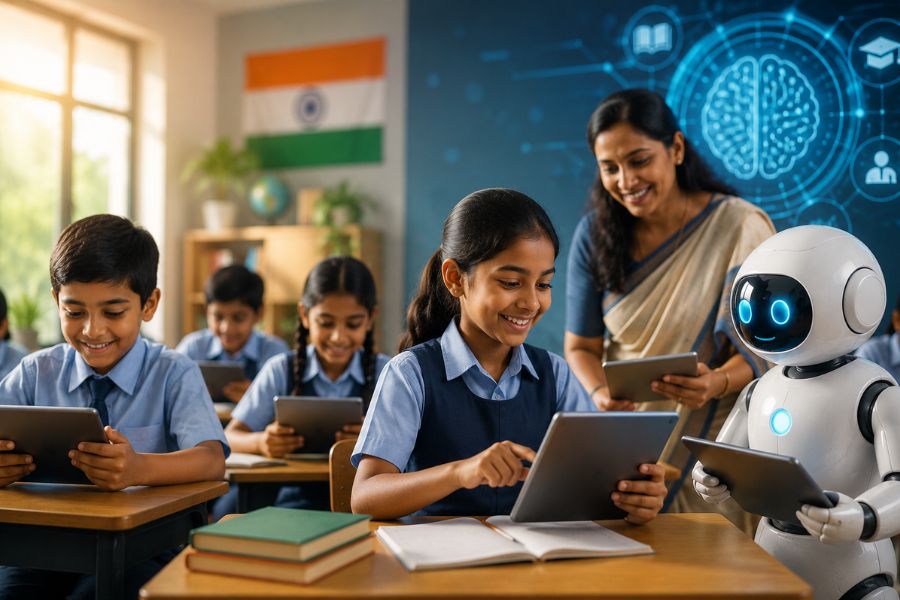
AI in Classrooms


An opinion article argues that India’s greatest artificial intelligence opportunity may not be in software exports or large technology companies, but inside its classrooms. The author suggests that AI could fundamentally improve learning outcomes, strengthen public education and prepare millions of students for an AI-driven economy.

The article presents the author’s analysis rather than verified findings or government policy.
According to the opinion, artificial intelligence should not replace teachers but instead become a powerful classroom assistant. AI tools could help educators identify learning gaps, personalise lesson plans, automate routine assessments and provide targeted support to students with different learning abilities.
The author argues that such technology could be especially valuable in India’s public education system, where teacher shortages, language diversity and unequal access to educational resources remain major challenges.
Recent research also points to AI’s potential to improve educational outcomes when implemented responsibly and alongside teacher training rather than as a substitute for educators.
The article argues that India’s large student population represents a unique strategic advantage. If AI becomes widely available across schools, it could improve educational quality while preparing students for future careers that increasingly require digital and AI literacy.
The author believes multilingual AI systems, adaptive learning platforms and intelligent tutoring could reduce educational inequality and improve access to quality instruction across urban and rural regions.
However, the opinion also notes that technology alone cannot solve educational challenges. Investment in teacher training, digital infrastructure, curriculum reform and responsible AI governance will remain essential.
The article highlights concerns including student privacy, data protection, algorithmic bias and unequal digital access. It argues that these issues should be addressed before AI is deployed at scale.
Experts broadly agree that AI has significant educational potential, but its effectiveness depends on careful implementation, transparent governance and maintaining the central role of teachers. Several recent reports have suggested that responsible AI adoption in education could improve learning outcomes and even contribute substantially to India’s long-term economic growth.
As this is an opinion article, its conclusions reflect the author’s interpretation rather than universally accepted fact. Nevertheless, it contributes to an increasingly important discussion about how India can use AI to strengthen one of the world’s largest education systems.








© Copyright 2026, cloudTV. All Rights Reserved