



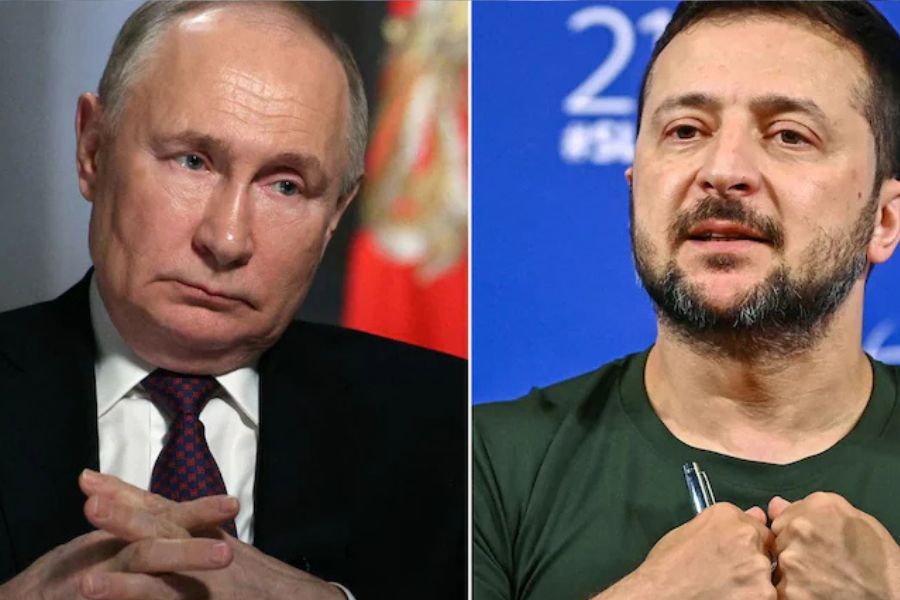
Zelensky warns Putin


The Russia-Ukraine war could be heading towards another dangerous escalation, with Ukrainian President Volodymyr Zelensky warning that Russian President Vladimir Putin may be preparing to mobilise around 500,000 additional fighters.

According to Zelensky, Ukrainian intelligence believes the mobilisation could take place after Russia’s parliamentary elections in September.
The claim has not been independently confirmed, and there has been no official announcement from Moscow confirming plans for a 500,000-strong mobilisation.
Zelensky has nevertheless warned that Russia may attempt to recruit additional personnel without openly announcing a large-scale mobilisation. He said the Kremlin could be concerned about the reaction of Russian society to another major mobilisation drive.
The warning comes as Russia and Ukraine continue to intensify long-range drone and missile attacks, while concerns are also growing over the possibility of further escalation.
Zelensky first raised the issue in a July 27 post on X, saying Ukrainian intelligence had information that Putin was preparing for another mobilisation after Russia’s parliamentary elections.
According to the Ukrainian president, the Kremlin could seek to increase its military strength without making a formal public announcement.
Zelensky also warned that Russia would struggle to train such a large number of recruits quickly.
That could result in poorly trained personnel being sent to the battlefield, potentially leading to heavier losses among Russian forces.
The figure of 500,000 therefore remains a claim attributed to Ukrainian intelligence rather than a confirmed Russian military decision.
The timing is nevertheless significant because the Russian leadership has repeatedly faced questions over manpower requirements during the prolonged war.
A large mobilisation would also carry substantial domestic and political consequences for the Kremlin.
Russia has previously used different recruitment mechanisms to maintain the size of its forces, while seeking to avoid the political consequences associated with another openly declared mass mobilisation.
Whether Moscow actually plans to introduce a new mobilisation campaign after September remains unclear.
For now, the warning has added another layer of uncertainty to a conflict that has already entered its fifth year.
The manpower warning has been accompanied by an even more serious concern: the possibility that Russia could eventually consider using nuclear weapons.
Turkish Foreign Minister Hakan Fidan has warned that the war could reach a point where Moscow considers its nuclear arsenal a “last resort”.
Fidan was speaking about the risks created by Ukraine’s increasingly deep strikes inside Russian territory.
He argued that if a war of attrition at the front develops into a broader war of attrition inside a country’s rear areas, the strategic calculations of the leadership could change.
Fidan described the situation as dangerous and said the issue had been discussed with Western partners.
His comments do not mean that Russia has decided to use nuclear weapons. Rather, they highlight the risks associated with continued escalation and increasingly deep strikes.
The possibility of nuclear escalation has remained one of the most serious international concerns since Russia launched its full-scale invasion of Ukraine in 2022.
However, Moscow has not crossed the nuclear threshold despite repeatedly issuing warnings related to its nuclear capabilities.
The latest comments therefore represent a warning about a potential scenario rather than confirmation of an imminent nuclear attack.
The latest warnings come as both sides have expanded their use of long-range weapons.
According to the NDTV report, a Ukrainian drone strike in Russia’s central Tatarstan region killed at least 13 people on Monday. The attack was described as one of the deadliest Ukrainian strikes since the beginning of the war.
Russia also launched deadly attacks against Ukraine.
Ukrainian officials said a Russian artillery strike in a village in the northeastern Kharkiv region killed five people.
Russia’s Defence Ministry claimed that its forces had shot down 456 Ukrainian drones launched overnight. The ministry did not specify how many drones may have reached their intended targets.
Ukraine’s Air Force, meanwhile, said Russia had launched 126 drones during its overnight attack.
The expanding drone war demonstrates how the conflict has increasingly moved beyond conventional front-line combat.
Both Russia and Ukraine are now capable of conducting long-range attacks against targets far from the immediate battlefield.
That development has increased the possibility of retaliatory strikes and further escalation.
If Russia were to begin a new mobilisation involving hundreds of thousands of people, the scale of the conflict could increase substantially.
At the same time, the deployment of poorly trained personnel could increase casualties without necessarily delivering a decisive military advantage.
The nuclear question remains even more sensitive.
There is currently no independent confirmation that Moscow is preparing to use nuclear weapons, nor is there confirmation that the Kremlin has decided to conduct a 500,000-person mobilisation.
But the combination of Zelensky’s intelligence warning, increased long-range attacks and Fidan’s nuclear concerns has created a renewed sense of danger around the conflict.
The immediate questions are therefore whether Russia will actually launch a new mobilisation after the September elections, how large that mobilisation might be, and whether continued attacks deep inside Russian territory could push the conflict towards a more dangerous phase.
For now, the 500,000 figure remains an unverified Ukrainian assessment. But the warning underlines how far the Russia-Ukraine conflict remains from a stable resolution.








© Copyright 2026, cloudTV. All Rights Reserved