



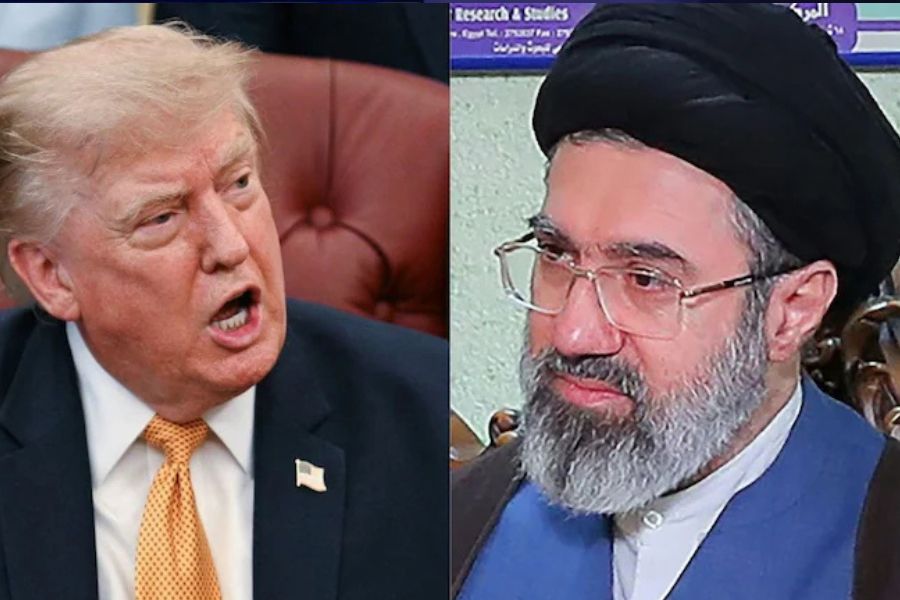
US Iran War


The conflict between Iran and the United States could potentially continue until the end of US President Donald Trump’s current term in January 2029, according to a senior Iranian military officer.

Mohammad Reza Naqdi, a general in Iran’s Islamic Revolutionary Guard Corps and a close aide to Supreme Leader Mojtaba Khamenei, suggested that Tehran could deliberately prolong the conflict as part of a strategy to establish deterrence against future attacks.
Naqdi made the comments in a rare interview with US broadcaster PBS. He argued that the longer the conflict continues, the more military experience Iran gains.
However, his comments should not be interpreted as an official announcement that Iran has decided to continue the war until 2029. Rather, he described prolonging the conflict as one possible strategy for achieving long-term deterrence.
Naqdi said Iran needs to create a situation in which any country considering an attack on Tehran understands that such an action would carry a significant cost.
According to him, prolonging the conflict could help Iran build military experience while imposing what he described as attrition on its opponents.
The comments are particularly significant because Trump’s current presidential term is scheduled to end on January 20, 2029.
Asked directly whether Iran’s objective was to continue the war until Trump leaves office, Naqdi linked a prolonged conflict to Iran’s goal of achieving deterrence.
He claimed that Iran had never previously experienced a real war with the United States and that the ongoing conflict had provided valuable battlefield experience.
The remarks come at a time when diplomatic efforts between Washington and Tehran remain stalled.
A June interim agreement designed to halt military operations and create a path toward a permanent settlement has effectively collapsed. Both sides have accused each other of violating commitments under the agreement.
The continuing confrontation has raised concerns about a prolonged regional conflict and its consequences for energy markets and international shipping.
During the interview, Naqdi was also questioned about the possibility of the United States using a nuclear weapon against Iran.
The Iranian commander issued a strong warning, saying such an action could become a serious mistake for Washington.
He claimed that the consequences would extend beyond the immediate battlefield and could put US military installations around the world at risk.
At the same time, Naqdi said Iran does not need a nuclear bomb.
He argued that Iran’s strength comes from public support and resistance rather than nuclear weapons. His comments appeared aimed at presenting Tehran’s military strategy as one based on deterrence and resistance rather than nuclear escalation.
Naqdi also addressed Iran’s missile and drone capabilities.
He claimed that Iran does not rely exclusively on missiles and drones and said the country’s military production capacity remains intact.
He further claimed that Iran could continue launching rockets even if the war lasted for years. These claims could not be independently verified from the available reporting.
The statements underline Tehran’s determination to project an image of sustained military capability despite the continuing pressure from Washington and its allies.
The latest warning comes as efforts to revive the US-Iran interim agreement remain stuck.
The June agreement was intended to stop military operations and create a 60-day pathway toward a broader and permanent settlement.
However, Trump declared the agreement over in July. Tehran subsequently suspended the memorandum, accusing Washington of failing to honour its commitments.
The dispute has also centred on the strategically important Strait of Hormuz.
Washington has accused Iran of failing to reopen the shipping route as required under the agreement. Tehran, meanwhile, has accused the United States of failing to lift its blockade of Iranian ports and release frozen Iranian assets.
Reuters reported on August 12 that there had been no significant progress toward reviving the interim arrangement.
The diplomatic deadlock means the military confrontation remains unresolved.
Naqdi’s remarks therefore add another layer of uncertainty to an already volatile situation.
A conflict extending for several more years could have consequences far beyond Iran and the United States. The Middle East could face prolonged instability, while energy supplies, shipping routes and global markets could remain vulnerable to disruption.
For now, however, there is no confirmation that the war will actually continue until 2029.
Naqdi’s comments represent a senior Iranian military figure’s assessment of a possible long-term strategy. Whether Tehran ultimately chooses prolonged confrontation or returns to negotiations will depend on developments on the battlefield and in diplomatic channels.
The coming months are therefore likely to be critical for determining whether the United States and Iran move toward another agreement or remain locked in a prolonged conflict.







© Copyright 2026, cloudTV. All Rights Reserved