



Iran Attack Strategy


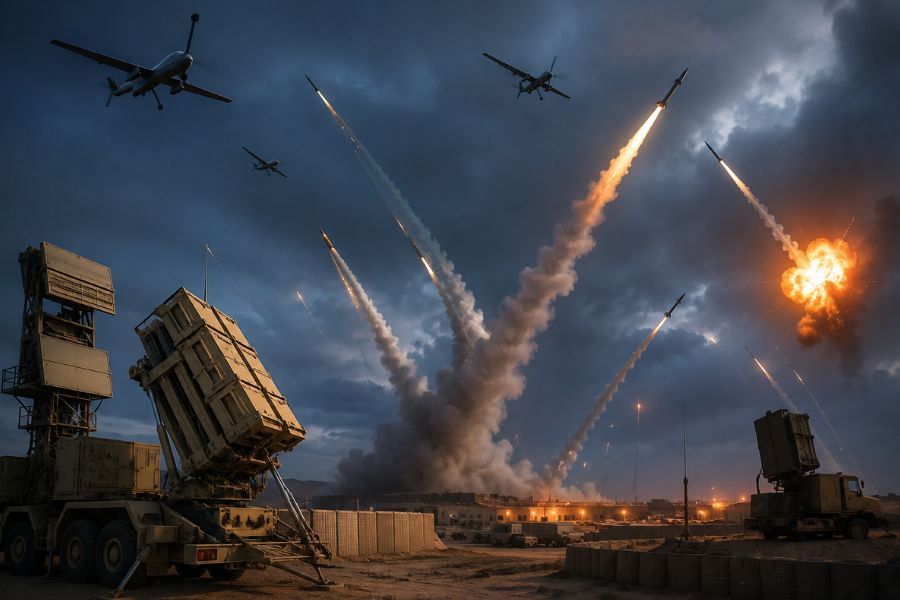
Iran has changed the way it conducts missile attacks against US military positions, increasingly combining drones with different types of missiles to put greater pressure on American air-defence systems.

According to a report, Tehran’s evolving strategy has been influenced in part by lessons from the Russia-Ukraine war. Russia has repeatedly combined drones with ballistic and cruise missiles in Ukraine, creating multiple simultaneous threats for air-defence systems. Iran is now using a similar broad approach in its attacks on US bases.
The shift comes after a series of Iranian attacks on US bases in Jordan, where Tehran sought to pressure American air defences and force the use of Patriot interceptor missiles.
Iran reportedly launched repeated waves of drones and missiles against three US bases in Jordan over a period of five days.
The objective was not simply to strike a target. The broader strategy was to place sustained pressure on American air-defence systems by sending different types of threats at the same time.
During the first four days, US air defences intercepted most of the incoming weapons.
However, on July 17, one Iranian missile reportedly penetrated the defences and struck temporary housing at a US military base in Jordan.
US Secretary of State Marco Rubio said that American forces had intercepted almost all the missiles but that one had managed to get through.
The strike killed three US soldiers and wounded more than 100 others, according to the report. Several aircraft were also reportedly damaged during attacks on US bases in Jordan that week.
The incident highlighted the difficulties involved in defending large military facilities against repeated attacks involving multiple types of weapons.
Iran has also used missiles described in the report as capable of changing direction during flight. Such manoeuvrability can make an incoming missile more difficult for defenders to track and intercept.
Military analysts have drawn parallels between Iran’s changing tactics and Russia’s approach in Ukraine.
Russia has frequently used combinations of drones, ballistic missiles and cruise missiles in attacks against Ukrainian targets.
The purpose of such mixed attacks is to create a complex air-defence environment, forcing defenders to respond to different types of threats simultaneously.
Seth G. Jones, president of the defence and security department at the Center for Strategic and International Studies, said the combination of missiles and drones makes the task of air-defence systems more difficult.
The change is significant because Iran’s missile infrastructure has itself been under sustained pressure.
The United States and Israel previously targeted several Iranian missile sites during the opening weeks of the conflict. Many of those facilities were underground.
Although Washington had assessed that Iran’s missile programme had suffered serious damage, some sites were subsequently restored and missile attacks resumed, according to the report.
This suggests that Iran has retained the ability to regenerate parts of its missile infrastructure despite the strikes.
The evolving tactics also demonstrate how battlefield lessons can spread from one conflict to another.
Iran’s new approach has also raised questions about the sustainability of US air-defence interceptor stocks.
According to two people briefed on US weapons inventories, cited by NDTV, the Pentagon has used more than 1,500 Patriot interceptors during the war and has fewer than 1,700 remaining.
The figures underline a key challenge in modern missile warfare.
Air-defence systems can successfully intercept incoming threats, but repeated large-scale attacks can consume expensive interceptor missiles at a significant rate.
That creates a difficult balance for defenders. They must protect military personnel and critical infrastructure while also managing limited stocks of high-value interceptors.
Iran’s mixed use of drones and missiles therefore creates pressure on two fronts: the physical challenge of tracking and intercepting multiple threats and the logistical challenge of sustaining defensive missile inventories.
However, the long-term effectiveness of Iran’s evolving strategy remains uncertain. The United States continues to possess sophisticated air-defence capabilities, while the actual performance of individual systems depends on factors including the type of threat, location and operational circumstances.
What is becoming increasingly clear is that Iran is adapting its attack methods rather than relying on a single form of missile strike.
The experience of the Russia-Ukraine war appears to have influenced this evolution, with Tehran increasingly using mixed waves of drones and missiles to complicate the defensive challenge.
The development also highlights a wider trend in modern warfare: air defence is increasingly becoming a contest not only of technology but also of endurance, logistics and the ability to adapt to changing tactics.








© Copyright 2026, cloudTV. All Rights Reserved