


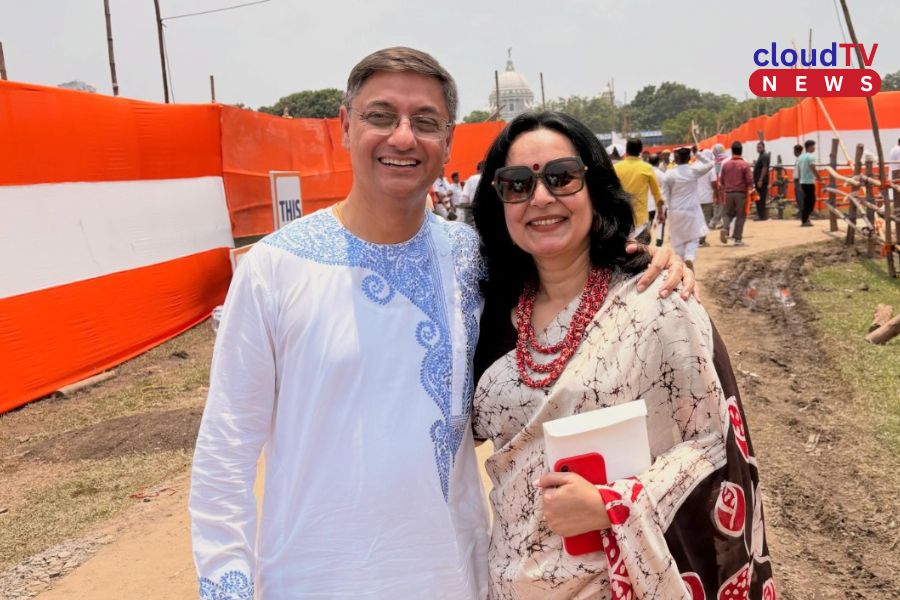
Sanjeev Sanyal Kolkata


Cloud TV Desk: “Reviving East India is impossible without reviving Kolkata.” That is the strong message delivered by Sanjeev Sanyal, economic advisor to Prime Minister Narendra Modi.

Speaking at an event in Mumbai titled “The Relative Economic Performance of Bharatiya States”, Sanyal argued that India’s biggest economic imbalance is not between North and South India, but between East and West India. According to him, rebuilding Kolkata as a major industrial and financial centre is essential for the economic resurgence of Eastern India.
His remarks have triggered fresh debate over Kolkata’s declining economic influence and the future growth model of Eastern India.
During his speech in Mumbai, Sanjeev Sanyal stated that the commonly discussed North-South divide is not India’s main economic problem.
Instead, he argued that the real imbalance exists between eastern and western India. He said Kolkata needs to regain its historic role as a major commercial and industrial city to correct that imbalance.
According to Sanyal, Kolkata should function as the “anchor engine” for the entire eastern seaboard and help drive industrial expansion, infrastructure growth and export-oriented development across Eastern India.
He also described Kolkata’s revival as not merely a regional issue but a “national project” necessary for India’s long-term economic ambitions and the goal of becoming a developed nation by 2047.
Sanyal pointed out that after the 1991 economic reforms, western and southern Indian states grew rapidly, while much of Eastern India lagged behind economically.
He noted that West Bengal’s contribution to India’s economy has declined dramatically — from around 11 percent after Partition to nearly 5.5 percent today.
According to him, Kolkata once served as one of India’s most important commercial cities, but decades of de-industrialisation weakened the city’s economic strength. He argued that Eastern India suffered because Kolkata stopped functioning as the region’s primary economic engine for nearly half a century.
Sanyal also said Bengal experienced not only industrial decline but also weakening educational and cultural institutions, leading to large-scale migration of talent from the state.
Sanyal believes Kolkata can once again emerge as a strategic gateway connecting India with Southeast Asia through trade, logistics and manufacturing.
He stressed the need for stronger infrastructure, integration with global supply chains and export-focused industrial policies centred around Eastern India.
According to him, rebuilding Kolkata’s economic ecosystem would help power a new phase of manufacturing and services-led growth in the eastern part of the country.
Sanyal’s comments come at a politically significant time following major political changes in West Bengal after the 2026 Assembly elections.
Political analysts believe his remarks may also indicate a broader policy push towards infrastructure development, industrial expansion and economic integration in Eastern India.
Experts say any serious attempt to revive Kolkata would require large-scale investments, modern transport systems, port-led development, industrial reforms and greater private-sector participation.
The debate now centres around whether Kolkata can realistically reclaim its historical position as one of India’s leading economic centres.







© Copyright 2026, cloudTV. All Rights Reserved