


Former Maoists


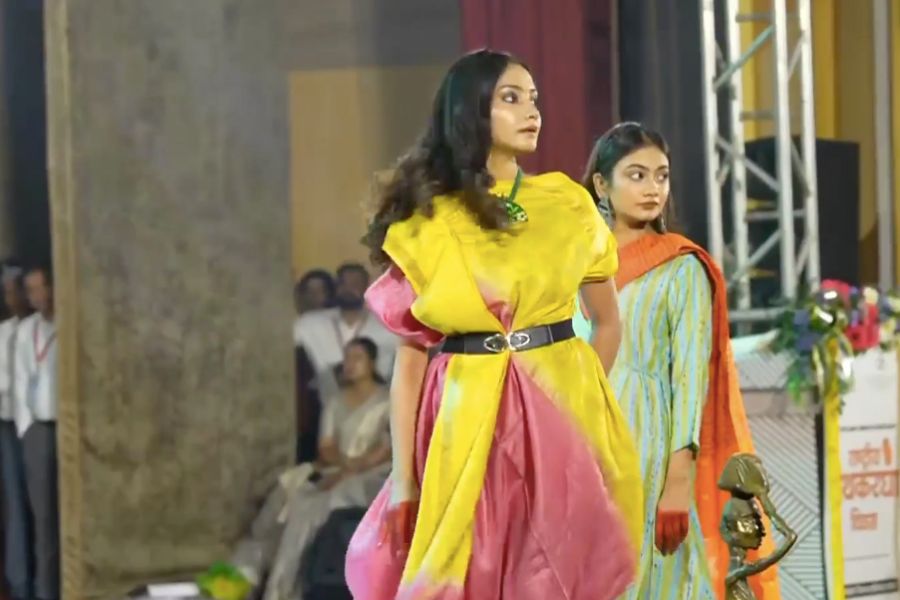
A group of former women Maoists in Chhattisgarh have taken part in a fashion show, marking a striking transformation from their previous lives in the forests of Bastar.

Once associated with the Maoist insurgency and accustomed to living in remote forest areas, the women appeared on a fashion runway wearing traditional handloom sarees.
Their appearance at the event in Raipur has attracted considerable attention online, with a video of the fashion show going viral on social media.
The event was organised around National Handloom Day and showcased India’s traditional handloom culture through contemporary fashion. For the former Maoists, however, the event represented something much larger than fashion.
#WATCH | Raipur, Chhattisgarh: Former women Naxals, who once carried weapons in the dense forests of Bastar, walked the ramp to huge applause at a National Handloom Day event in Raipur after joining the mainstream. (07.08) pic.twitter.com/51mc8lEXWE
— ANI (@ANI) August 13, 2026
It offered a public demonstration of their return to civilian life after giving up arms and choosing rehabilitation.
Bastar has long been associated with the Maoist insurgency in central India.
The heavily forested region of Chhattisgarh was once considered one of the strongest areas of Maoist influence.
For years, armed Maoist groups operated from remote forest locations across the region.
Women were also part of these groups and often lived for extended periods away from towns and villages.
Their lives were shaped by the realities of armed insurgency, security operations and the difficult conditions of the forest.
Over the years, however, a number of Maoists have surrendered and entered government rehabilitation programmes.
The process of leaving an armed organisation is only the first step.
Former insurgents also need employment, vocational training, social acceptance and opportunities to build an independent civilian identity.
The women who appeared at the Raipur fashion show are now attempting to build that new identity.
Their confident appearance on the runway offered a stark contrast to their earlier lives.
Instead of uniforms and weapons, they appeared in handloom sarees and walked in front of an audience as fashion participants.
The transformation has been widely described as a symbol of reintegration into mainstream society.
National Handloom Day is observed in India to celebrate the country’s traditional weaving and textile heritage.
The occasion has increasingly been used to promote Indian handloom products and encourage contemporary interpretations of traditional clothing.
Fashion shows held around the day often feature sarees and other handloom garments presented in modern styles.
The Raipur event followed the same broad theme.
But the participation of former women Maoists gave the programme a distinctive social dimension. For women who once spent years living in remote forest areas, appearing publicly on a fashion runway represented a dramatic change.
Their presence also demonstrated how rehabilitation can extend beyond surrender and security measures. A successful reintegration programme requires people to develop livelihoods and social connections after leaving insurgent groups.
Public events can help former insurgents regain confidence and become visible members of mainstream society.
The viral video from the event has therefore attracted attention not simply because of the unusual fashion show but because of the personal journeys represented by the participants. Many viewers have responded positively to the transformation.
The images provide a sharp contrast between the perception of Maoist insurgency and the possibility of life after surrender.
The fashion show also comes against the backdrop of changing security conditions in Bastar. For decades, Maoist violence affected several districts of southern Chhattisgarh.
Security forces conducted extensive operations against armed groups, while the government also encouraged insurgents to surrender and enter rehabilitation programmes. Union Home Minister Amit Shah has repeatedly spoken about the government’s objective of making India free of Maoist violence.
The government has highlighted declining insurgent activity and increased surrender numbers as evidence of progress. The transformation of former Maoists into ordinary members of society has become an important part of the rehabilitation narrative.
However, the wider debate over the Maoist conflict remains complex.
While the government emphasises security gains and the decline of armed insurgency, rights groups and critics have also raised concerns about civilian rights, displacement and the conditions faced by people in conflict-affected areas. Against this larger background, the former Maoist women walking a fashion runway represent a very personal aspect of the transition.
Surrender does not automatically erase years spent in an armed movement. Former insurgents often face significant challenges in adapting to ordinary life. They need sustainable employment, skills and acceptance from their communities.
They also have to develop a sense of identity outside the organisation they once belonged to.
The Raipur fashion show offered one visible example of that process. The women were not presented as fighters. They were presented as citizens participating in a cultural and fashion event.
That change in identity is perhaps the most significant aspect of the story. The journey from Bastar’s forests to a fashion runway is unlikely to be a simple one. It reflects a broader process of rehabilitation, reintegration and social transformation.
The viral video has brought that process to a much wider audience.
For many viewers, the images symbolise the possibility of leaving violence behind and rebuilding a civilian life. The runway may have lasted only a few minutes, but the journey behind it has taken years. And for the former Maoist women who walked that runway, the handloom saree represented more than traditional Indian fashion.
It represented a new chapter in their lives.








© Copyright 2026, cloudTV. All Rights Reserved