



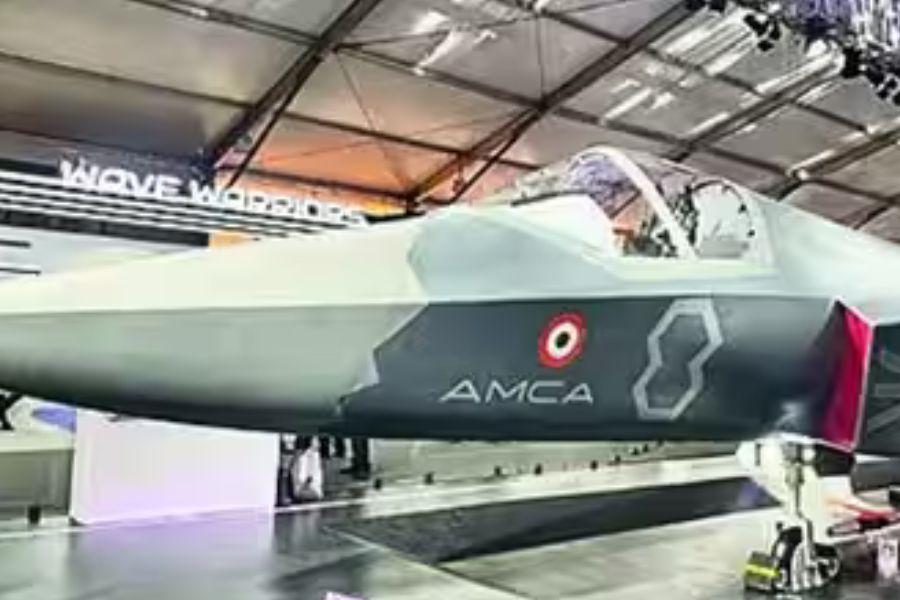
AMCA Engine


India’s ambitious fifth-generation fighter aircraft programme has received a major boost. Reliance Industries and British aerospace giant Rolls-Royce have announced a strategic partnership to explore the development of an engine for India’s Advanced Medium Combat Aircraft, or AMCA.

The AMCA is being developed as an indigenous fifth-generation stealth fighter for the Indian Air Force. The aircraft programme is considered one of India’s most important defence technology projects.
The engine has emerged as one of the most critical challenges for India’s fighter aircraft programmes. The country has historically depended on foreign suppliers for advanced fighter engines.
The new Reliance-Rolls-Royce initiative could therefore become an important step towards building a domestic aerospace propulsion ecosystem.
As part of the strategic partnership, the two companies said they would explore setting up an Aerospace Gas Turbine Complex in India.
The proposed facility would aim to develop capabilities across the engine’s entire lifecycle. This could include design, development, manufacturing, testing, production, maintenance and long-term support.
The partnership would combine Rolls-Royce’s experience in advanced aero-engine technology with Reliance’s capabilities in technology, manufacturing, scale and project execution.
Reliance Industries Executive Director Anant Ambani said strategic autonomy requires sovereign capabilities in critical technologies. He said the partnership could help create a self-reliant aerospace engine ecosystem that could eventually become globally competitive.
Rolls-Royce CEO Tufan Erginbilgic described the initiative as a major milestone towards building a robust and self-reliant aerospace ecosystem in India.
The proposed complex could eventually support projects beyond the AMCA engine. The companies said it could potentially contribute to defence, civil aerospace and emerging power and propulsion technologies.
However, the announcement should not be interpreted as a final engine contract or a completed joint venture.
The two companies have so far described the arrangement as a strategic intent to explore the proposed Aerospace Gas Turbine Complex. Investment details, ownership structure and a firm construction timeline have not yet been disclosed.
The AMCA is planned as India’s first indigenous fifth-generation stealth fighter. The aircraft is expected to incorporate advanced stealth features, internal weapons bays, sensor fusion, supercruise capability and next-generation avionics.
For a fifth-generation fighter, the engine is far more than a propulsion system. It directly affects the aircraft’s performance, range, acceleration, reliability and overall combat capability.
India’s AMCA programme is expected to use a foreign engine for its initial variant. The more advanced AMCA Mk2, however, is expected to require a significantly more powerful indigenous powerplant.
Earlier reports have indicated that the Mk2 could require an engine in the 110-130 kilonewton thrust class.
This makes the engine partnership strategically important.
Rolls-Royce had previously proposed establishing an aero gas turbine complex in India and had offered to collaborate on an engine for the AMCA programme. The company has also stressed the importance of building deeper aerospace capabilities in India.
The British company is not the only contender. French aerospace and defence major Safran has also been involved in discussions over co-developing a future engine for India’s fifth-generation fighter programme.
The latest Reliance-Rolls-Royce announcement therefore adds another significant dimension to India’s search for an indigenous high-thrust fighter engine.
For India, the larger objective is clear: reduce dependence on foreign propulsion systems and build domestic expertise in one of the most difficult areas of aerospace engineering.
If the proposed facility becomes a reality, it could provide India with capabilities extending from engine design and manufacturing to testing and lifecycle support.
That would make the initiative important not only for the AMCA but potentially for India’s wider military and civil aerospace ambitions.








© Copyright 2026, cloudTV. All Rights Reserved