


Suvendu Durga Puja controversy


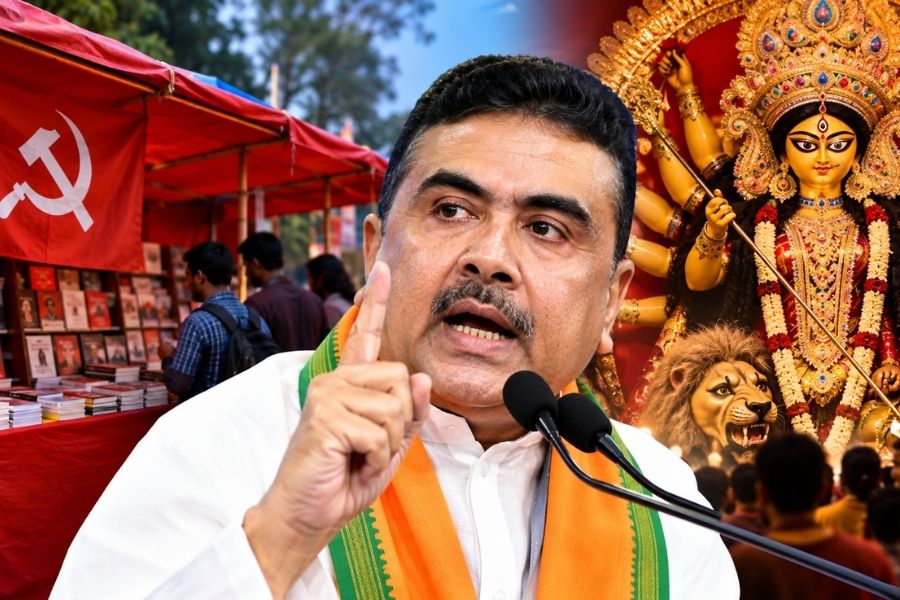
West Bengal Leader of Opposition Suvendu Adhikari has criticised the Left parties over their Marxist literature and magazine stalls set up during Durga Puja. He said that if such stalls use the term ‘Sharadotsav’ instead of ‘Durga Puja’, organisers should not be allowed to set them up.

Addressing Durga Puja committees in the Assembly, Suvendu Adhikari alleged that some academics associated with the Left selectively target Sanatan traditions and saffron politics. He appealed to Puja committees not to allow Communist book stalls if they refer to the festival as ‘Sharadotsav’ rather than ‘Durga Puja’.
His remarks underline his view that Durga Puja should not be described merely as a cultural festival, but that its religious identity should also be acknowledged.
During West Bengal’s long Left rule, Marxist literature and magazine stalls outside Durga Puja pandals became a familiar feature of the festival season. These stalls provided an opportunity for Left organisations to connect with visitors and promote their political and ideological literature.
The practice declined significantly after 2011. Large CPM book stalls are now less commonly seen outside Puja pandals, although such stalls continue to operate in a few selected locations, including parts of Kolkata. Marxist books, political literature and party publications are still sold at these stalls.
The tradition of setting up book stalls during Durga Puja dates back to 1954, when Muzaffar Ahmed reportedly initiated such a stall at Park Circus. The practice subsequently became associated with Left political and literary activism, and similar stalls continue to be seen in the area.
Suvendu Adhikari has now brought this tradition into a fresh political debate. He said he has no objection to selling books or promoting an ideology, but argued that a stall set up during Durga Puja should explicitly acknowledge the festival as ‘Durga Puja’.
His remarks have once again brought questions surrounding religion, Bengali cultural identity and political ideology to the forefront of the state’s political discourse.








© Copyright 2026, cloudTV. All Rights Reserved