


Trump Russia sanctions bill


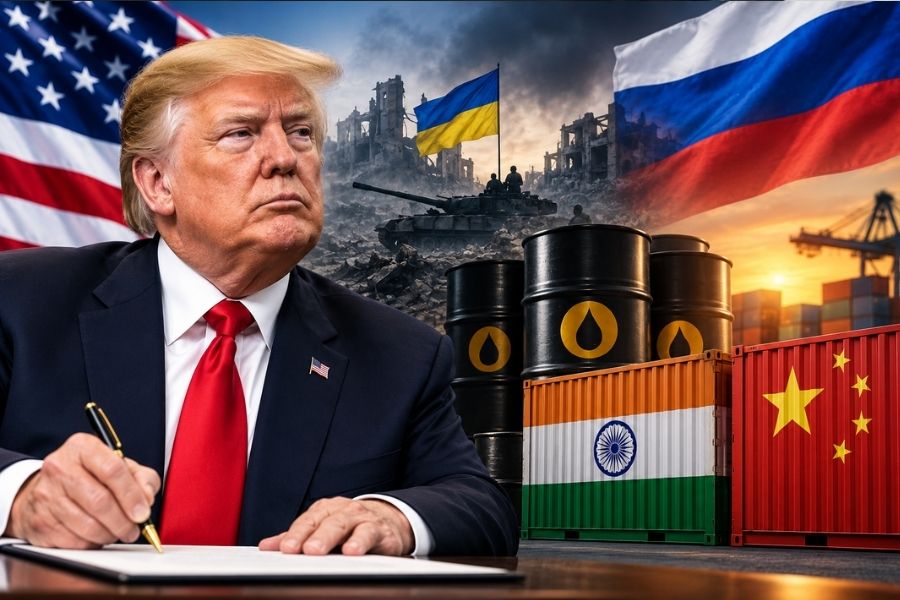
US President Donald Trump has signed into law a sweeping Russia sanctions measure, expanding Washington’s economic pressure on Moscow amid the Russia-Ukraine war.

The legislation gives the US administration the authority to impose tariffs of up to 100% on goods from countries that fall under provisions targeting major buyers of Russian oil and gas. India and China could potentially be affected because both are major purchasers of Russian crude.
However, the law does not automatically impose a 100% tariff on India or China. It creates a legal framework allowing the US president to impose such duties under specified conditions.
The legislation is officially called the Lindsey O. Graham Sanctioning Russia and Iran Act of 2026.
The US House of Representatives approved the measure by a 262-159 vote after the Senate had already passed it. Trump signed the legislation on September 18.
The law targets Russian officials, banks and financial institutions, while also expanding pressure on Russia’s energy and defence sectors.
It also includes measures targeting Russia’s so-called shadow fleet, a network of tankers that Washington and other Western governments have accused of helping Moscow circumvent sanctions and continue oil exports.
One of the most significant provisions gives the president authority to impose tariffs of up to 100% on goods from major buyers of Russian oil and natural gas.
The broader objective is to reduce the revenues available to Moscow while increasing economic pressure over the war in Ukraine.
India and China are among the world’s major buyers of Russian crude. That makes both countries potentially vulnerable to the new US tariff mechanism.
The legislation provides for duties of up to 100% on goods imported from countries that qualify under its provisions concerning major Russian oil and gas purchasers. It also covers countries that help Russia evade existing energy sanctions.
Importantly, the legislation does not specifically announce an immediate 100% tariff on Indian goods.
Instead, it gives Trump substantial discretion over whether and how the tariff powers are used.
The eventual impact on Indian exporters will depend on several factors, including the tariff rate, the products covered and the implementation schedule.
The law also contains provisions that allow for exemptions or waivers under certain circumstances.
India has maintained that its priority is ensuring energy security for its population of more than 1.4 billion people.
The Indian government has said it will continue to source energy from diversified suppliers and adjust purchases according to changing market conditions.
New Delhi has also previously communicated to US officials its concerns about the potential implications of restrictions on India’s Russian oil trade for bilateral relations and global energy markets.
For India, the immediate issue is therefore not an already imposed 100% tariff, but the possibility that Washington could use the new authority.
If such tariffs are eventually imposed, Indian exporters to the US could face significantly higher costs and greater uncertainty. Exporters have already warned that the consequences would depend on the final tariff rate and the products covered.
The new law therefore adds another layer of uncertainty to US-India trade relations, while also increasing Washington’s economic pressure on Russia amid the continuing Ukraine conflict.








© Copyright 2026, cloudTV. All Rights Reserved