


Salah Shehadeh killing


Salah Shehadeh was one of the senior commanders of Hamas’s military wing. Israeli security agencies accused him of being directly involved in planning and directing a series of attacks against Israelis.

According to Israeli intelligence records cited in accounts of the operation, attacks between July 2001 and July 2002 that were attributed to Shehadeh’s network killed 474 people and injured 2,649 others.
Shehadeh operated from the Gaza Strip and had become a major target for Israel’s Shin Bet security service.
Several attempts were reportedly considered to eliminate him. However, concerns about civilian casualties repeatedly affected the planning.
Former Shin Bet chief Avi Dichter later said that the presence of Shehadeh’s daughter was one of the reasons earlier plans were not approved. Israeli officials have said that intelligence was gathered to determine who was present around the target before an operation was authorized.
On 22 July 2002, Israeli intelligence located Shehadeh in a residential area of Gaza City.
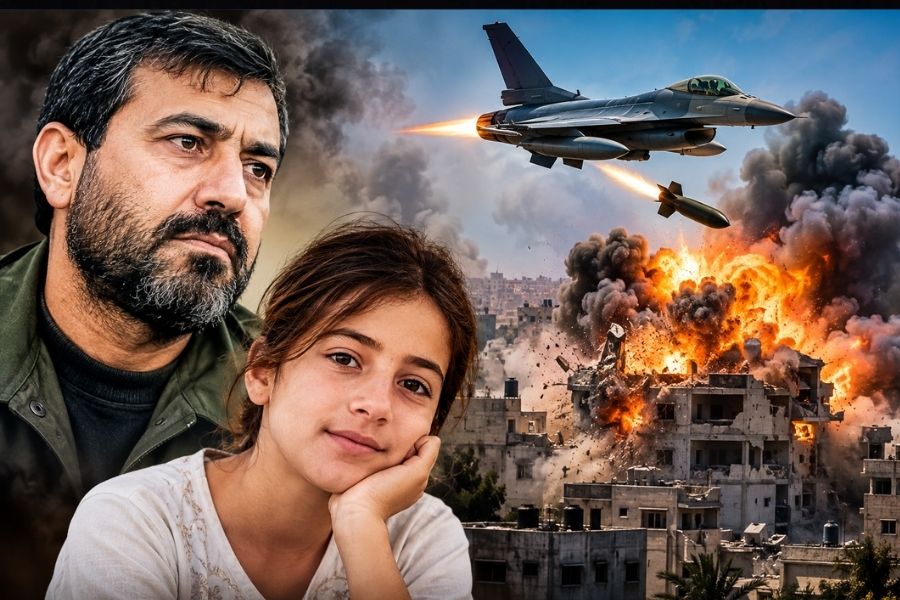
According to Human Rights Watch and contemporary reports, Israeli Prime Minister Ariel Sharon and Defense Minister Binyamin Ben-Eliezer approved the operation. An Israeli F-16 aircraft then dropped a roughly one-ton bomb on the residential building where Shehadeh was located.
Shehadeh and one of his associates were killed. His wife was also killed.
However, the strike caused extensive civilian casualties.
Human Rights Watch initially reported that 13 civilians were killed and around 140 were injured. Later accounts placed the number of civilian deaths at 14 or more.
Amnesty International documented a higher toll of 17 deaths, including nine children. Among those killed was Shehadeh’s 15-year-old daughter, Iman Salah Shehadeh.
The strike triggered strong international criticism. Human Rights Watch argued that the use of such a large bomb in a densely populated residential area raised serious questions about whether sufficient precautions had been taken to protect civilians.
A later Israeli inquiry also identified shortcomings in the intelligence and in the assessment of civilians in and around the target area. The inquiry indicated that more accurate information about civilians could have changed the timing or method of the attack.
The operation therefore became controversial even within Israel’s own security establishment.
Salah Shehadeh was successfully killed. But the strike also killed his wife, an associate and numerous civilians, including children.
Among them was Iman.
The July 2002 strike remains a significant case in the history of the Israeli-Palestinian conflict because it illustrates the difficult intersection of intelligence, targeted killings, military decision-making and the protection of civilians.









© Copyright 2026, cloudTV. All Rights Reserved