


Shashi Tharoor BRICS


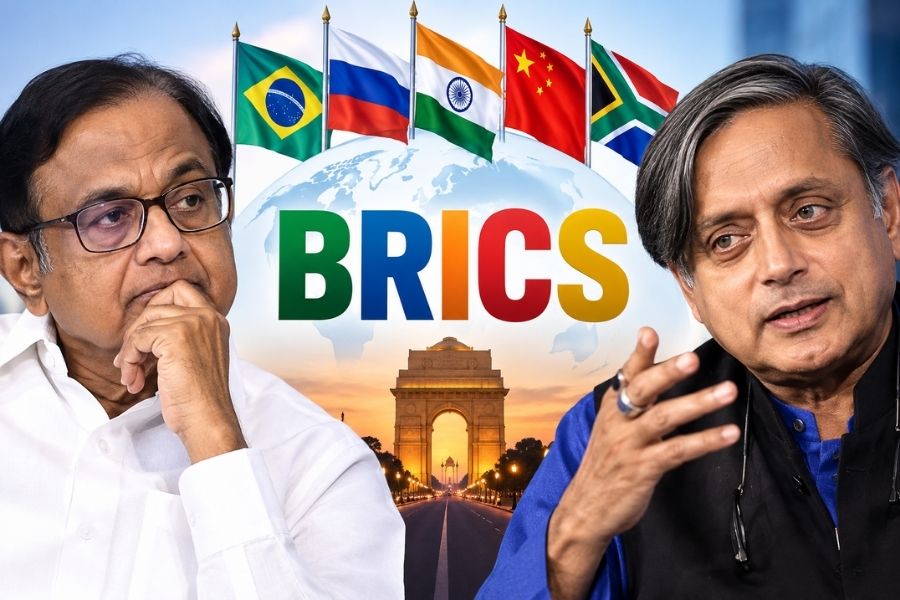
Ahead of the BRICS Summit 2026 in New Delhi, Congress leaders P Chidambaram and Shashi Tharoor have offered contrasting assessments of what the grouping means for India.

A day after senior Congress leader P Chidambaram questioned the tangible benefits India has gained from recent BRICS summits, party colleague and MP Shashi Tharoor highlighted the grouping’s diplomatic value, its importance for the Global South and India’s ability to bring major world leaders together.
Speaking ahead of the BRICS Summit, former Union minister and Rajya Sabha MP P Chidambaram questioned what India had actually gained from recent multilateral engagements.
Chidambaram pointed to India’s membership of BRICS, the Shanghai Cooperation Organisation, the G20 and the QUAD and asked what concrete benefits these groupings had delivered.
He said he had not seen significant tangible benefits or results from the last two or three BRICS summits, although he acknowledged that earlier BRICS meetings had produced some concrete gains for India.
The BJP responded by criticising Chidambaram’s remarks and questioning the Congress’s approach to India’s diplomatic engagement.
Shashi Tharoor offered a different assessment of the grouping’s significance.
Speaking ahead of the Delhi summit, Tharoor described BRICS as an important platform for the Global South. He noted that the expanded grouping of 11 countries represents a majority of the world’s population and around 41% of global GDP.
For Tharoor, the significance of BRICS therefore extends beyond immediate economic gains. The grouping provides India with a platform to engage major countries of the Global South and participate in discussions on global economic and political issues.
Tharoor also described India’s hosting of the BRICS summit as a matter of prestige.
With heads of state and government from BRICS countries and other participating nations expected in Delhi, he said the summit demonstrates India’s diplomatic “convening power” — its ability to bring major international actors together on Indian soil.
He suggested that this diplomatic value should be considered alongside more easily measurable economic outcomes.
Tharoor was also clear that BRICS has significant limitations.
One of the biggest challenges, he said, is the difficulty of achieving consensus among countries with very different strategic interests.
He cited disagreements over the Iran conflict and the Russia-Ukraine war. At the BRICS foreign ministers’ meeting in New Delhi in May, differences between member countries prevented the group from issuing a joint declaration. India, as chair, instead issued a Chair’s Declaration.
Tharoor warned that another failure to reach consensus could be interpreted as evidence of fundamental incoherence within the grouping.
Tharoor also identified a more immediate economic concern: India’s trade imbalance with BRICS countries.
While trade among BRICS members has been growing, he pointed out that the trend has not necessarily been favourable to India. Indian exports to BRICS countries have declined, while imports from those countries have increased.
This means that rising trade volumes alone cannot be treated as proof of economic benefit for India.
The contrasting comments from Chidambaram and Tharoor reflect two different ways of assessing India’s participation in BRICS.
Chidambaram has focused on tangible, measurable outcomes from recent summits. Tharoor, while acknowledging the economic and political challenges, has placed greater emphasis on diplomatic influence, India’s role within the Global South and the strategic value of hosting major international leaders.
As India prepares to host the BRICS Summit on September 12 and 13, the debate over what India actually gains from the grouping is likely to remain a key part of the political discussion.








© Copyright 2026, cloudTV. All Rights Reserved