



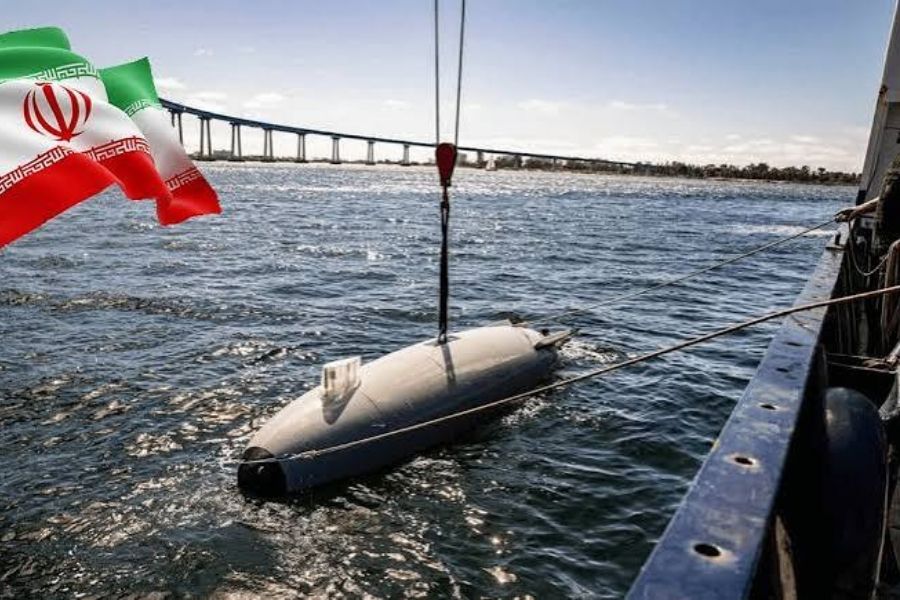
Iran captures US submarine drone


Iran has claimed that its forces captured a US unmanned underwater vehicle near the entrance of the strategically vital Strait of Hormuz, releasing footage that it said showed the American system in its possession (Iran captures US submarine drone). The Islamic Revolutionary Guard Corps (IRGC) described the operation as a complex intelligence and operational mission and identified the vehicle as a Dive-LD autonomous underwater vehicle.

The United States, however, has offered a sharply different account. American military officials said an underwater drone operating in regional waters had malfunctioned more than a day earlier. According to the US Central Command, the defective vehicle was an older model and neither collected sensitive information nor carried classified sonar or radar equipment.
Iranian state media reported that the IRGC Navy had captured what it described as one of the US military’s most modern and sophisticated unmanned submarines at the entrance to the Strait of Hormuz. The Iranian military said the vehicle represented advanced subsurface technology and later released footage purportedly showing the captured system.
The vehicle has been identified as the Dive-LD, an autonomous underwater vehicle developed by California-based defence technology company Anduril. It is not a conventional crewed submarine. Instead, the unmanned system can be used for missions including seabed mapping, underwater surveillance, mine detection and inspection of submerged infrastructure such as cables and pipelines.
According to Reuters, the Dive-LD is approximately 19 feet (5.8 metres) long and can operate for up to 10 days without returning to base. It is designed to reach depths of up to 6,000 metres. Individual units have been reported to cost around $2.5 million.
Following Iran’s announcement, the US military said one of its underwater drones had malfunctioned while surveying regional waters in support of ongoing operations.
A US Central Command spokesperson described the vehicle as defective and said it was an older model. The US military also stressed that it did not contain sensitive information or classified sonar or radar equipment.
Importantly, Washington did not explicitly confirm that the vehicle shown in Iranian footage was the same drone that had malfunctioned. That leaves a key gap between the two narratives: Iran portrays the incident as a successful intelligence operation and capture, while the US describes the loss as involving an older unmanned system that had already become inoperable.
The incident comes at a particularly sensitive moment in the US-Iran confrontation. The Strait of Hormuz is one of the world’s most important energy corridors, with a significant share of global oil and gas shipments traditionally passing through the narrow waterway. Any escalation involving military vessels, drones or commercial shipping in the area can therefore have wider consequences for energy markets and global trade.
The latest incident is also part of a broader escalation in the region. US Central Command has claimed that American forces destroyed five Iranian crude oil tankers following attacks by Iran’s Revolutionary Guard on a US warship. Separately, the IRGC claimed that Iranian air defences shot down an MQ-9 Reaper drone over the Strait of Hormuz.
The competing claims over the underwater vehicle underline the growing importance of autonomous military systems in the conflict. Both the US and other militaries are increasingly turning to unmanned platforms for surveillance, intelligence gathering and hazardous maritime missions, reducing the need to put personnel directly in harm’s way.








© Copyright 2026, cloudTV. All Rights Reserved