



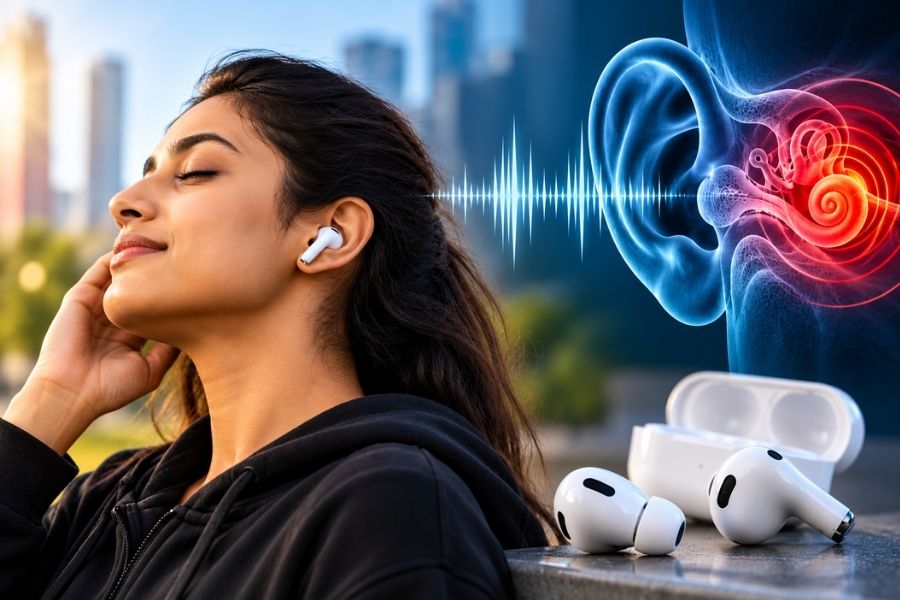
earbuds hearing loss


Wireless earbuds have rapidly become part of everyday life in India. From music and podcasts to phone calls and videos, millions of people now rely on personal audio devices throughout the day.

But as earbud use grows, so does concern over the consequences of listening to loud audio for prolonged periods. Experts say the problem is not simply the use of earbuds. The bigger issue is how loud the sound is, how long people listen and how frequently they are exposed to loud audio.
Repeated exposure to loud sounds can damage sensitive cells in the inner ear and may result in permanent noise-induced hearing loss.
Earbuds are increasingly used during commutes, at work, while exercising and during leisure time.
The risk can become greater in noisy environments such as public transport or busy streets. People often turn up the volume to drown out surrounding noise, increasing their overall sound exposure.
The World Health Organization says more than one billion young people worldwide are at risk of hearing loss because of unsafe recreational listening practices. Personal audio devices are one of the sources of potentially harmful sound exposure.
Earbuds themselves should not be described as an automatic cause of hearing loss. The key factors are the volume, duration and frequency of exposure.
According to WHO, the louder the sound, the shorter the safe listening time. At an average level of 80 decibels, listening for up to 40 hours a week falls within the organisation’s example of a safe exposure limit. At 90 decibels, however, the corresponding weekly limit drops to just four hours.
Repeated exposure to loud sound can fatigue the sensory cells in the ear. Continued or repeated exposure can eventually cause irreversible noise-induced hearing loss and tinnitus.
AIIMS Delhi experts have also warned about the consequences of prolonged exposure to loud music and other sounds through headphones and personal audio devices.
They note that hearing loss caused by prolonged exposure can develop gradually, which means people may not recognise the damage in its early stages. Once significant noise-induced damage occurs, it can be irreversible, although it is largely preventable.
AIIMS experts recommend keeping personal audio devices below 60% of their maximum volume and taking a break after around 60 minutes of listening.
WHO recommends keeping device volume at no more than 60% of maximum and taking regular breaks from loud sounds.
It also recommends well-fitted, noise-cancelling headphones in noisy environments. The reason is straightforward: better isolation can reduce the temptation to increase the volume simply to overpower surrounding noise.
WHO also recommends monitoring sound exposure where possible and choosing devices with built-in safe-listening features such as volume limiting and exposure monitoring.
Persistent ringing or buzzing in the ears, difficulty hearing high-pitched sounds and trouble following conversations in noisy surroundings can be warning signs of hearing problems.
Temporary ringing after loud music may disappear as the ears recover. However, persistent tinnitus can indicate hearing damage and should not be ignored. WHO recommends seeking professional advice if tinnitus persists or hearing difficulties develop.
Experts are not necessarily asking people to stop using earbuds altogether. The emphasis is on changing listening habits.
Keeping the volume down, taking regular breaks, avoiding prolonged exposure to loud audio and using well-fitted noise-cancelling devices in noisy environments can help reduce the risk.
So, millions of earbuds being sold in India do not by themselves prove that the country is facing a hearing crisis. But widespread high-volume, prolonged and repeated use of personal audio devices could add to the burden of preventable hearing loss if safer listening habits are not adopted.









© Copyright 2026, cloudTV. All Rights Reserved