



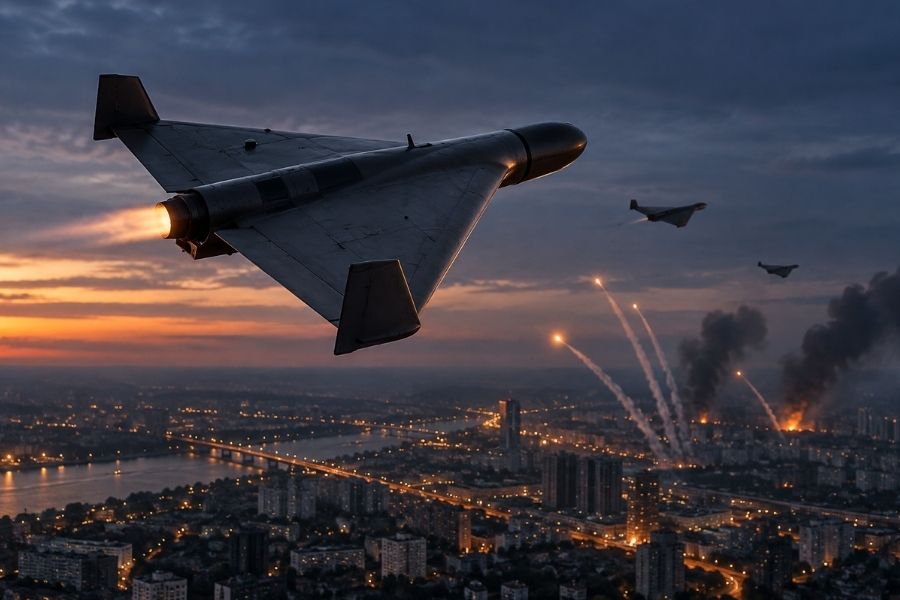
Geran-5 drones


Russia is rapidly expanding its use of jet-powered attack drones in the war against Ukraine. Among the newest systems, the Geran-5 has emerged as a major challenge for Ukrainian air defence. The drone can reportedly reach speeds of around 600 kilometres per hour.
Its range can extend to nearly 1,000 kilometres, depending on the variant.

Earlier Shahed-type drones were slower and could often be targeted by mobile fire teams and relatively inexpensive interceptor systems. Ukraine had previously achieved high interception rates against many of these slower drones.
The jet-powered Geran variants have changed that equation. Their higher speed and operating altitude reduce the time available for detection and interception. Newer variants may also carry electronic-warfare capabilities designed to interfere with interceptor systems during the final stage of an attack.
Ukrainian officials have also highlighted the guided nature of the newer drones. Their flight path and altitude can reportedly be adjusted during the mission.
That makes predicting their final approach more difficult for defenders.
Speed is only one part of Russia’s strategy. The other is scale.
Russia used around 450 jet-powered drones in June. The number reportedly climbed to about 2,850 in August. Jet-powered drones accounted for a substantial share of several large attack packages.
The objective is not simply to hit individual targets. Repeated waves can force Ukraine to consume interceptors, missiles and personnel resources. They can also keep air-defence crews operating continuously. Russian attacks increasingly target infrastructure such as power generation, gas facilities, logistics networks and defence production. The broader effect is to put pressure on Ukraine’s ability to sustain military operations and maintain critical infrastructure.
Geran-5 also highlights a changing economic equation in modern warfare.
A relatively inexpensive, mass-produced drone can force a defender to consider using much more expensive missiles or other interceptors.
Latest Geran variants as occupying a space between traditional drones and cruise missiles. Their combination of speed, range and mass production gives them a role in sustained long-range strike campaigns. Ukraine is now exploring faster interceptor drones, guided weapons, electronic warfare and improved detection systems.
Reuters reported that Ukrainian forces are working on new counter-drone solutions as Russian jet-powered attacks become more frequent.
The development has implications beyond the Russia-Ukraine war.
Military planners in other countries are also examining how to defend against large numbers of fast, relatively inexpensive aerial weapons.
The emerging lesson is that future air defence may depend not only on sophisticated missiles. It could also require large numbers of affordable interceptors, faster detection and automated targeting systems.









© Copyright 2026, cloudTV. All Rights Reserved