


Ajit Doval Mizoram Sikkim


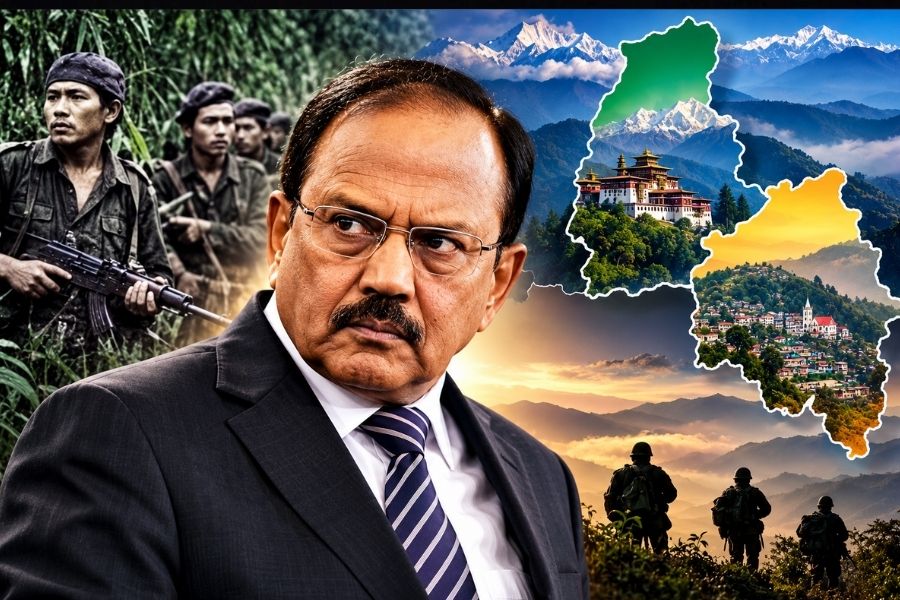
India’s National Security Advisor Ajit Doval built much of his early intelligence career in sensitive regions, particularly in the Northeast. His role during the Mizo insurgency has become one of the most widely discussed episodes of his career.

His name has also been linked to India’s handling of the political crisis in Sikkim before its integration with India in 1975. However, the historical record indicates that the Sikkim process involved several political and intelligence actors and cannot accurately be described as the work of a single officer.
The roots of the Mizo insurgency can be traced to the food crisis that followed widespread bamboo flowering in the late 1950s. Laldenga emerged as an important leader of the movement. The Mizo National Famine Front later became the Mizo National Front, or MNF.
In 1966, the MNF launched an armed rebellion and demanded independence from India. The Indian government deployed the armed forces to contain the insurgency. The Indian Air Force also conducted strikes against insurgent positions, making the episode an important chapter in India’s post-independence counter-insurgency history.
Ajit Doval joined the Indian Police Service in 1968 and was allotted the Kerala cadre. He moved to the Intelligence Bureau in 1972. Mizoram subsequently became one of his major intelligence assignments.
Biographical accounts state that Doval headed the IB’s Subsidiary Intelligence Bureau in Aizawl during the 1970s and spent considerable time working undercover.
The most prominent account of his Mizoram career concerns his efforts to establish contact with the MNF leadership. According to several accounts, Doval succeeded in bringing six of Laldenga’s seven senior commanders into contact with the Indian side. This weakened the insurgent organisation and helped create conditions for a political process.
Doval’s Mizoram assignment ended in the 1970s, but the political process continued for years.
Laldenga eventually entered negotiations with the Indian government. In 1986, during Prime Minister Rajiv Gandhi’s tenure, the Mizoram Peace Accord was signed. Laldenga subsequently became Chief Minister of Mizoram.
The 1986 settlement, however, cannot be attributed solely to Doval. It followed years of armed conflict, political negotiations, military operations and efforts by successive governments to bring the insurgency into the political mainstream.
Doval’s contribution is particularly associated with intelligence-led engagement with insurgent leaders rather than relying exclusively on military force. His efforts to split or weaken the MNF leadership became a defining part of the public narrative surrounding his early career.
The story of Sikkim was different. Before 1975, Sikkim had a special relationship with India. Under the 1950 treaty, the Chogyal retained control over internal administration while India had a major role in defence and foreign affairs.
Political tensions increased during the early 1970s. Pro-democracy forces and political groups favouring closer integration with India became increasingly influential.
The Research and Analysis Wing, or R&AW, became involved in the political developments. Former R&AW officer G. B. S. Sidhu wrote that he led a small R&AW team in Gangtok in 1973. His role included liaising with political parties and supporting democratic and pro-integration forces.
The Sikkim Congress led by Kazi Lhendup Dorji won the 1974 elections. A new political framework subsequently reduced the powers of the monarchy.
In 1975, a referendum was held. According to the recorded figures, 59,637 votes were cast in favour of abolishing the monarchy and joining India, while 1,496 were cast against. The Indian Parliament subsequently passed the 36th Constitutional Amendment, and Sikkim formally became India’s 22nd state on 16 May 1975.
Therefore, describing the integration of Sikkim as an operation personally engineered by Ajit Doval would oversimplify the historical record. Available historical accounts specifically document the role of R&AW officer G. B. S. Sidhu, alongside the Indian government and pro-democracy political forces in Sikkim.
Doval’s role in Mizoram, meanwhile, remains one of the most prominent episodes associated with his early intelligence career. His reported success in establishing contact with six of Laldenga’s seven senior commanders became a key element of the story of India’s efforts to weaken the Mizo insurgency and eventually move towards a political settlement.








© Copyright 2026, cloudTV. All Rights Reserved