



China Job Crisis


For decades, China built its economic rise on manufacturing, exports and an enormous pool of relatively low-cost labour. It became the world’s factory floor.

But the factory is still running—with fewer people.
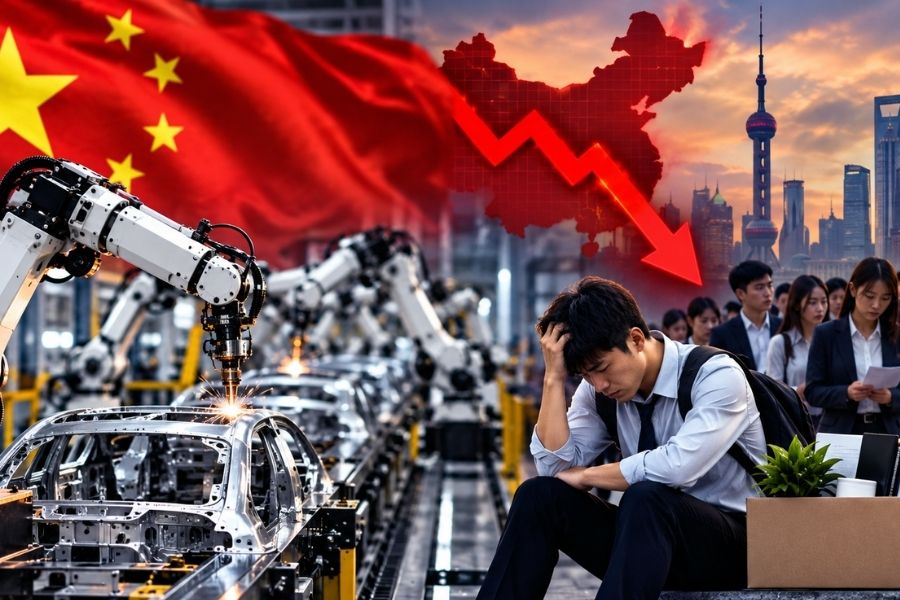
Automation, artificial intelligence and robotics are transforming Chinese manufacturing, while the real estate downturn and shifting global supply chains are putting additional pressure on employment. The result is an increasingly difficult job market, particularly for young people and fresh graduates.
China is facing a record influx of graduates in 2026, with 12.7 million young people entering the workforce.
But the number of available jobs has not kept pace with the expanding graduate pool. According to report, China’s unemployment rate for people aged 16 to 24 stood at 15.6% in May.
Official data later showed that the rate rose to 17.9% in July, the highest level in 11 months.
For millions of young Chinese, the traditional path from university to a stable corporate job is becoming increasingly difficult.
One recent incident illustrates the pressure facing China’s white-collar job market.
Changzhou Xingyu Automotive Lighting, a major auto-parts manufacturer in eastern China, hired 440 fresh graduates this year. Just weeks later, 107 of them were dismissed.
The episode generated widespread anger in China. The company subsequently acknowledged management failures and a lack of empathy.
The incident is significant because it reflects a broader structural problem rather than simply one company’s employment practices.
Manufacturing output can continue to grow even as the number of workers required to produce that output declines.
China has aggressively invested in industrial automation, robotics and artificial intelligence.
The country’s robotics industry is expanding rapidly, with companies developing robots for manufacturing, logistics and other applications. Humanoid robotics is also receiving substantial investment, although the technology remains far from capable of replacing humans across complex industrial environments.
The employment problem, therefore, cannot simply be described as “robots taking all the jobs”.
A combination of higher productivity, automation, changes in global supply chains, weaker sectors and the restructuring of China’s economy is reducing demand for some categories of labour.
China’s prolonged real estate downturn has also hit employment.
According to report, more than 14 million workers left China’s construction industry between 2021 and 2025 as the property boom collapsed. At the same time, more workers are turning to the gig economy for income, with China’s gig workforce projected to reach around 320 million in 2026.
That shift suggests that stable employment is becoming harder to find even as people continue working.
China’s manufacturing job losses do not automatically mean India will become the next global factory.
Rishi Shah, Economic Advisory Lead at Grant Thornton Bharat, told that China’s manufacturing employment fell from about 152 million in 2013 to 134 million in 2025. Yet China’s share of global manufactured exports continued to rise.
The key point is that China’s manufacturing capacity has not necessarily declined. Instead, productivity has increased, allowing the country to produce more with fewer workers.
India has already attempted to capture part of the global manufacturing shift through initiatives such as the Production-Linked Incentive scheme. According to figures cited by news media, PLI schemes had generated 1.45 million jobs and attracted Rs 2.4 trillion in investment by FY26.
But becoming a long-term manufacturing alternative to China will require India to move beyond assembly into components, research, advanced manufacturing and deeper supply chains.
China’s experience offers India both an opportunity and a warning: manufacturing growth does not automatically translate into mass employment when productivity and automation rise rapidly.









© Copyright 2026, cloudTV. All Rights Reserved