



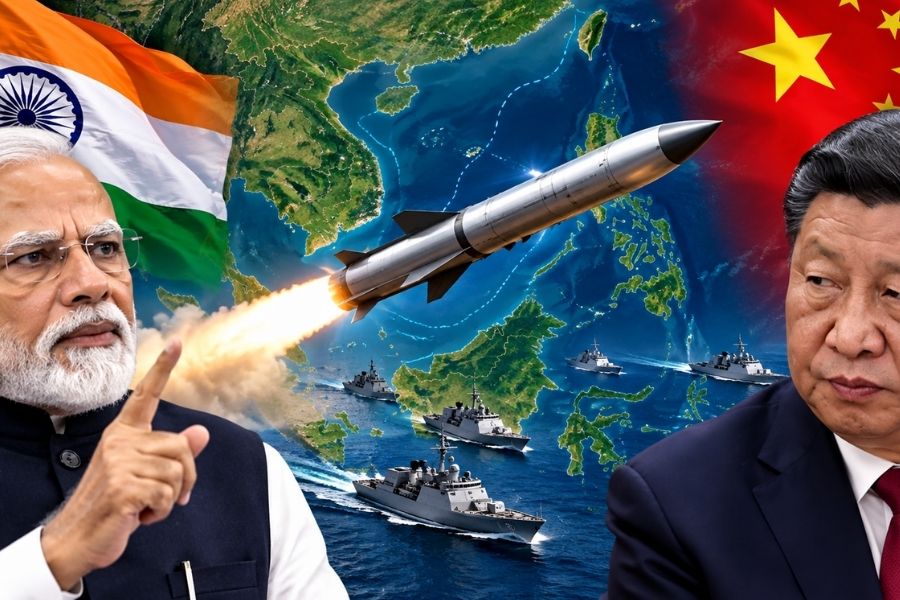
India BrahMos Belt


India appears to be strengthening its strategic footprint around the South China Sea through defence partnerships with ASEAN countries rather than by directly expanding its military presence in the region.

The Philippines, Vietnam and Indonesia have already entered into agreements involving BrahMos missiles, while Malaysia and Thailand could potentially join the growing list. The emerging network is being described as a ‘BrahMos Belt’ that could create an additional layer of strategic pressure on China.
China’s growing presence in the South China Sea and the wider Indo-Pacific has caused concern among several ASEAN countries. Against this backdrop, India’s BrahMos supersonic cruise missile is emerging as an important option for strengthening coastal defence.
Retired Lieutenant General PR Shankar discussed the development in an interview with international media outlet Taiwan Talks. According to him, the strategy is not simply about targeting China but about building a stronger regional security architecture.
The Philippines became the first ASEAN country to acquire BrahMos missiles from India, reportedly signing a deal worth around $375 million in 2022 for its coastal defence requirements.
Vietnam and Indonesia have subsequently entered into agreements with India involving BrahMos. Malaysia and Thailand could also join the list, potentially expanding the missile’s presence across several countries bordering the South China Sea.
Several of these countries have maritime disputes with China, making the expansion of their coastal strike capabilities strategically significant.
According to PR Shankar, the term ‘BrahMos Belt’ does not refer to a formal military alliance.
Instead, it describes the growing network of defence partnerships between India and countries that have maritime disputes or strategic concerns involving China.
The former military officer argued that China has already seen the capabilities of BrahMos. A wider deployment of the missile among India’s regional partners could therefore create a new strategic challenge for Beijing.
BrahMos is one of India’s most prominent supersonic cruise missile systems. Its reported use during Operation Sindoor has further increased international attention around the weapon.
Developed through India-Russia cooperation, BrahMos is known for its high speed and precision strike capabilities. Its deployment in coastal defence can provide countries with a significant deterrent against maritime threats.
The South China Sea is one of the world’s most important maritime trade routes, carrying a substantial share of global commerce.
China claims sovereignty over a large portion of the waters, leading to longstanding disputes with Vietnam, the Philippines, Malaysia, Brunei and Taiwan.
China has also increased its patrols and maritime activities in the region in recent years. This has encouraged several coastal states to strengthen their maritime and coastal defence capabilities.
The key element of India’s approach is that New Delhi does not necessarily need to establish a direct military presence in the South China Sea to influence the strategic balance.
By strengthening the defence capabilities of regional partners, India can contribute to a wider network of deterrence. If more countries in the region acquire BrahMos, China could face a more complex strategic environment across the South China Sea.
Rather than constituting a formal military alliance, the emerging defence partnerships could represent a broader effort to strengthen India’s strategic ties with countries seeking to balance China’s growing regional influence.









© Copyright 2026, cloudTV. All Rights Reserved