



dogs detect cancer


What if cancer could be detected before conventional symptoms become obvious, simply by analysing the chemical clues present in a person’s breath? Scientists and researchers are exploring exactly that possibility by combining the extraordinary sense of smell of trained dogs with artificial intelligence.

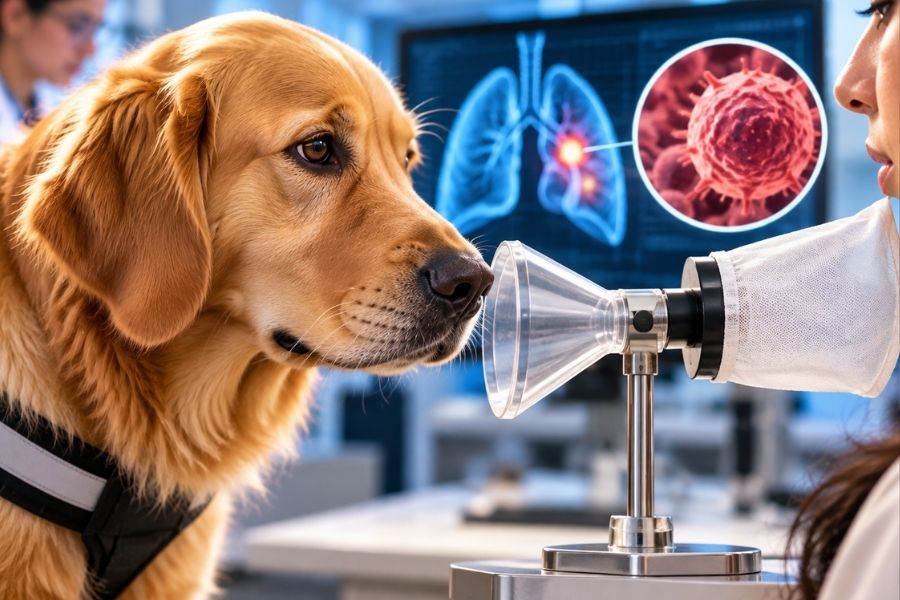
Bengaluru-based startup Dognosis is developing an experimental cancer-screening approach in which trained dogs analyse human breath samples for chemical signatures associated with cancer. Sensors record the animals’ responses while AI systems analyse patterns in their breathing, movements and other physiological signals.
Cancer can alter metabolic processes inside the body, potentially leading to changes in the volatile organic compounds, or VOCs, released through breath, sweat and urine. Some researchers believe that trained dogs can detect these compounds because their olfactory systems are extraordinarily sensitive.
In the Dognosis approach, a person breathes into a cotton mask for around 10 minutes. The sample is then sealed and transported to a laboratory, where a trained dog is exposed to it. Sensors and AI are used to capture and interpret the dog’s response rather than relying solely on a human handler’s observation.
The concept could potentially make cancer screening non-invasive and relatively simple, because the patient would only need to provide a breath sample.
Dognosis says a recent study involving more than 1,500 participants across six hospitals in Karnataka produced an accuracy rate of over 90% across seven types of cancer. The result has generated interest because early cancer detection can significantly improve the prospects of treatment.
However, the figure needs to be interpreted cautiously. The 90% result is a company-reported finding and does not, by itself, establish canine-AI screening as a clinically validated diagnostic test.
Independent oncologists have described the findings as promising but have stressed the need for much larger studies before definitive conclusions can be drawn. The technology will also need to demonstrate how consistently it performs in real-world populations and how often it produces false-positive or false-negative results.
The idea of using dogs to detect disease is not new. Researchers have spent years investigating whether trained dogs can distinguish cancer samples from healthy samples using breath, urine and other biological materials.
A systematic review of canine cancer-detection research found promising evidence across several cancer types, but also highlighted significant differences in study design and performance. Researchers have argued that identifying the precise chemical compounds dogs respond to could eventually lead to laboratory-based diagnostic technologies that reproduce the animals’ remarkable olfactory abilities.
Another double-blind study involving trained dogs found that they could identify lung-cancer samples from breath and urine with substantial accuracy. Yet the researchers emphasised that further work was necessary before the method could be translated into routine clinical practice.
For now, experts are cautious. The most realistic future application may not be for dogs to replace biopsies, scans or laboratory tests, but to serve as an initial screening or triage tool that identifies people who may require further medical investigation.
That possibility could be particularly significant in India, where late diagnosis remains a major challenge and an inexpensive, non-invasive screening method could potentially encourage more people to undergo follow-up testing.
Dognosis is working towards a potential commercial launch in 2027. But before such a system can become part of mainstream healthcare, it would require large-scale clinical trials, independent validation and regulatory scrutiny.
So, can dogs really sniff out cancer? The scientific evidence suggests that trained dogs can detect chemical differences associated with some cancers, but the technology remains experimental and is not a substitute for medical diagnosis.









© Copyright 2026, cloudTV. All Rights Reserved