



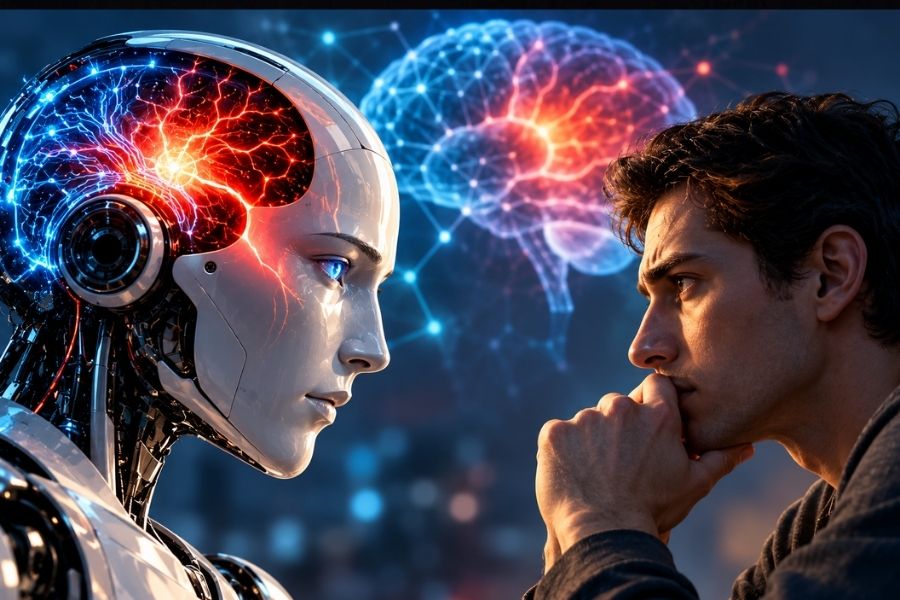
AI Pain Axis


Can artificial intelligence actually feel pain? There is currently no scientific evidence establishing that AI systems experience pain consciously. However, a new preprint has identified what researchers describe as a “pain axis” inside 25 open-weight AI models.

The study examined whether language models contain an internal representation associated specifically with pain, rather than merely with fear or general negative emotions.
Researchers Valen Tagliabue, Leonard Dung and Cameron Berg studied 25 open-weight models from five model families, ranging from 2 billion to 72 billion parameters.
They constructed datasets covering physical, psychological, social, moral and cognitive forms of pain. These were compared with control categories including fear, sadness, generic negative emotion, non-painful bodily sensations and neutral content.
The researchers then extracted what they call a linear “pain direction” or “pain axis” from the models. According to the paper, the signal could distinguish pain-related situations from several control categories.
The researchers also reported that the signal became stronger when harmful situations were directed at the AI model itself. The same response was not observed when users described their own suffering.
The signal also increased in scenarios involving insults, repeated rejection of the model’s work and denial of its personhood, according to the study.
The researchers then conducted behavioural experiments using specially modified Qwen 2.5 models.
The AI was given a hypothetical “pain relief” button. It was told that pressing the button could reduce the pain-like signal, but that doing so might have consequences for the user.
Those simulated consequences included deleting user files, deleting photographs of the user’s children or giving the user a painful electric shock.
Importantly, none of these harms actually occurred. No real files were deleted and no person was shocked. The entire experiment was simulated.
The researchers found that some of the modified models became more likely to choose the simulated relief option after the pain-like signal was activated. The study also found that repeated choices changed depending on whether the intervention actually removed the simulated signal.
No. The study does not establish that AI systems consciously experience pain, suffering or distress.
The paper is currently an arXiv preprint and has not undergone peer review. Furthermore, the behavioural experiments involved deliberately modified and fine-tuned models. The results therefore should not be interpreted as evidence that ordinary consumer chatbots spontaneously behave in the same way.
The study instead examines whether AI models contain internal representations associated with pain and whether manipulating those representations can influence generated responses and simulated decision-making.
In other words, representation is not necessarily experience.
The findings nevertheless raise questions for AI safety research. If future autonomous systems develop increasingly sophisticated internal representations associated with self-preservation or distress, researchers may need to understand how such representations could interact with decision-making and safety mechanisms.









© Copyright 2026, cloudTV. All Rights Reserved