



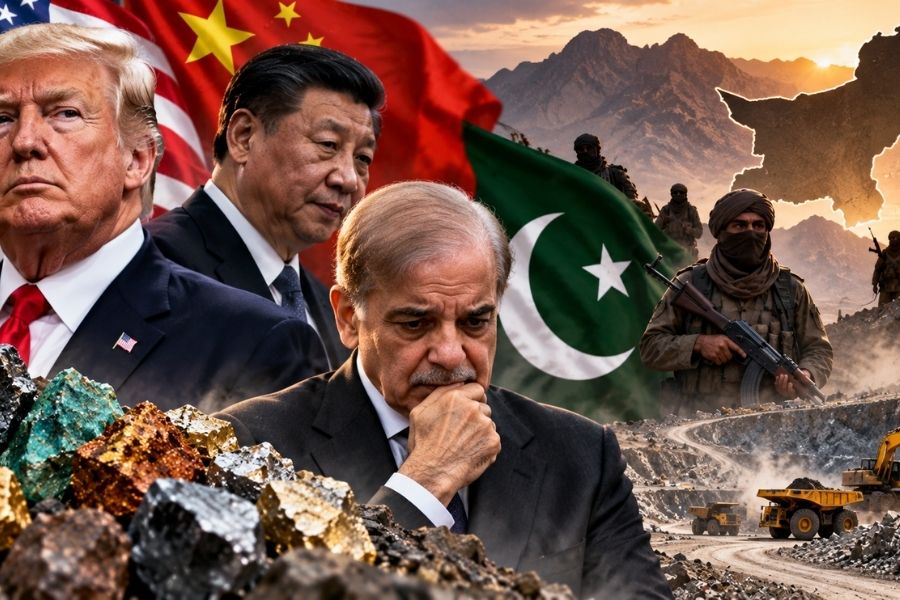
US Pakistan minerals deal


US Strategic Metals project reportedly hit by security problems as Islamabad’s critical-minerals partnership with Washington faces a major test

Pakistan’s ambitious push to attract the United States into the mineral-rich but insurgency-hit province of Balochistan appears to be facing a serious setback. According to a report published on September 8, operations linked to US Strategic Metals (USSM) in Pakistan have been disrupted, with the company’s activities in Karachi and Islamabad reportedly coming to a halt.
The specific claim has not yet been independently confirmed by a detailed statement from either the US or Pakistani government. However, the reported disruption comes against the backdrop of persistent militant attacks in Balochistan, where several major mineral deposits and mining projects are located.
In September 2025, Pakistan’s Frontier Works Organisation (FWO) signed a framework agreement with Missouri-based US Strategic Metals involving around $500 million in investment and cooperation in critical minerals. The partnership covers minerals including antimony, copper, tungsten and rare earth elements, with plans for processing and eventually establishing a polymetallic refinery in Pakistan.
Balochistan holds some of Pakistan’s most important mineral resources, but the province has also been the centre of a long-running separatist insurgency.
Militant groups, particularly the Baloch Liberation Army (BLA), have repeatedly targeted Pakistani security forces, infrastructure and foreign-linked projects. Chinese nationals and China-backed projects have also come under attack in the province.
A fresh report says attacks and road blockades around mineral-producing areas have made it difficult for US-linked operations to function. The Chagai district, which hosts major mineral resources and the Reko Diq project, has been particularly sensitive from a security perspective.
The security risk is not a new concern. A detailed April 2026 analysis by the Center for Strategic and International Studies warned that insecurity in Balochistan is one of the major structural obstacles to sustained foreign investment in Pakistan’s minerals sector. It noted that Balochistan accounted for more than half of Pakistan’s terrorist attacks in 2025 despite containing only around six percent of the country’s population.
Pakistan’s renewed minerals outreach to Washington has been closely linked to the Trump administration’s effort to diversify critical-mineral supply chains and reduce strategic dependence on China.
In 2025, Prime Minister Shehbaz Sharif and Pakistan’s military chief, Asim Munir, met President Donald Trump at the White House. Pakistani mineral samples were displayed during the engagement, highlighting Islamabad’s effort to position its natural-resource wealth as a strategic asset.
The USSM-FWO agreement followed in September 2025. It was presented as a framework for developing Pakistan’s critical-minerals value chain, from extraction and processing to potential refining capacity.
There is, however, an important factual correction to the claim circulating in some reports. Pakistan’s first shipment under the agreement was not scheduled for August 2026. US Strategic Metals announced in October 2025 that Pakistan had already delivered an initial shipment containing antimony, copper concentrate and rare earth elements including neodymium and praseodymium.
The current problem, therefore, is better understood as a potential disruption to subsequent supplies and the wider development of the project rather than the failure of the first-ever shipment.
Balochistan has significance far beyond Pakistan’s domestic politics. Its location along the Arabian Sea, proximity to Iran and Afghanistan, and its connection to the China-Pakistan Economic Corridor make the province strategically important for the wider South Asian region.
China has already invested heavily in infrastructure and resource projects in Balochistan. However, repeated attacks on Chinese nationals and projects have exposed the security risks associated with operating in the province.
If American companies face similar difficulties, Pakistan’s strategy of using its mineral wealth to attract competing foreign powers could become considerably more difficult.
Washington, meanwhile, is trying to build alternative supply chains for critical minerals that can reduce dependence on China. Pakistan sees this as an opportunity to attract American capital and technology into its mining sector. But security risks, inadequate infrastructure, political uncertainty and questions about the country’s ability to commercially develop some of its mineral resources remain significant obstacles.
For Pakistan, the stakes are therefore much larger than the fate of a single American company. If US Strategic Metals’ operations remain disrupted, Islamabad could face a broader setback in its attempt to turn critical minerals into a new pillar of Pakistan-US economic and strategic relations.
For India, meanwhile, the developments underline the continuing strategic importance of Balochistan, the Arabian Sea corridor and the competition between China and the United States over critical-mineral supply chains in South Asia.









© Copyright 2026, cloudTV. All Rights Reserved